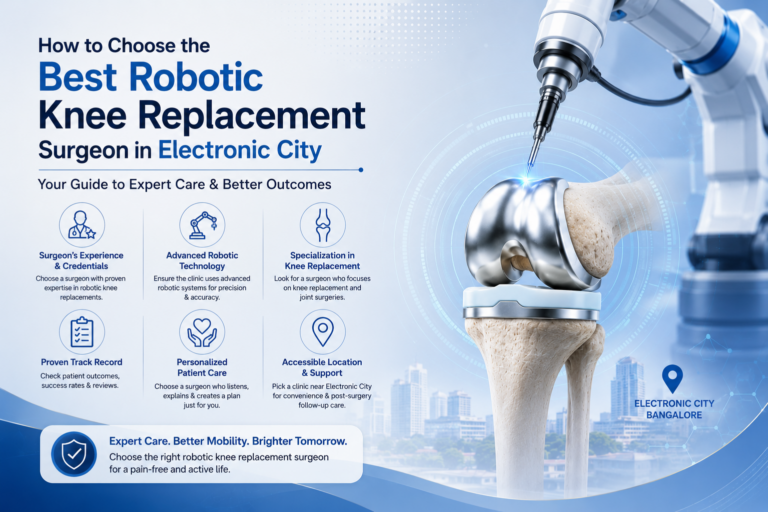

Choosing a robotic knee replacement surgeon for complex knee arthritis requires evaluating qualifications, robotic certifications, and surgical experience. Dr. Abhinandan Punit is a European Board Certified Orthopaedic Surgeon with 15+ years of experience, advanced training from the University of Edinburgh, and expertise in robotic-assisted knee replacement using MAKO, CORI, and Cuvis systems. He performs 700+ joint replacements annually at Elite Orthocare and Narayana Health City in Bangalore.
About Dr. Abhinandan Punit
Dr. Abhinandan Punit is a Senior Consultant & Clinical Lead for Joint Replacement and an Orthopedic & Robotic Joint Replacement Surgeon in Bangalore with European Board Certification in Orthopaedic Surgery. He holds advanced qualifications including MS Orthopaedics, DNB Orthopaedics, MCh Orthopaedics from the University of Edinburgh (UK), and MSc Sports & Exercise Medicine from the University of South Wales.
With 15+ years of clinical and surgical experience, Dr. Abhinandan Punit has established himself as a trusted specialist in robotic joint replacement in Bangalore. He is certified in MAKO robotic surgery, CORI robotic system, and Cuvis technology, making him proficient in multiple advanced robotic platforms. Annually, he performs 700+ joint replacement surgeries, including 200+ Direct Anterior Approach (DAA) hip replacements and 300+ sports medicine procedures. His comprehensive practice encompasses 1000+ orthopaedic procedures yearly.
He practices at Elite Orthocare & Multi-Speciality Clinic on Kanakapura Road and Narayana Health City in Bangalore. Dr. Abhinandan Punit is an active member of ISHKS (Indian Society of Hip, Knee & Shoulder Surgeons) and ISTA (Indian Sports Trauma Association), demonstrating his commitment to staying current with international standards in orthopedic practice.
What Is Complex Knee Arthritis?
Complex knee arthritis refers to advanced degenerative joint disease that goes beyond simple osteoarthritis, often involving structural damage to cartilage, bone, ligaments, or a combination of multiple joint problems. This condition typically develops after years of wear and tear, injury, or inflammatory joint diseases. Complex knee arthritis may include:
- Severe cartilage loss across multiple compartments of the knee joint
- Bone-on-bone contact causing pain and reduced mobility
- Significant ligament damage affecting knee stability
- Bone deformities or angular misalignment (varus/valgus deformity)
- Previous joint surgery or revision cases requiring specialized expertise
- Inflammatory arthropathies like rheumatoid arthritis affecting the knee
Unlike mild or moderate arthritis, complex knee arthritis often fails to respond adequately to conservative treatments such as physiotherapy, medications, or injections. These cases require advanced surgical planning and precision—which is where robotic-assisted knee replacement becomes highly valuable.
When Is Robotic Knee Replacement Recommended?
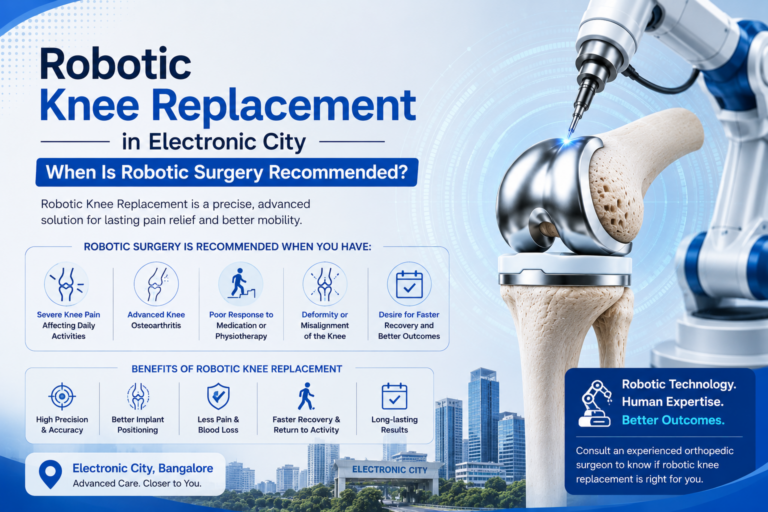
Robotic knee replacement surgery is recommended when conservative treatments have failed and your knee function continues to decline. Your orthopedic surgeon may recommend this procedure when:
- Conservative treatments have been exhausted – medication, physiotherapy, injections, or bracing haven’t provided lasting relief
- Severe pain limits daily activities – walking, climbing stairs, or basic tasks become unbearable
- Significant cartilage wear is confirmed – imaging shows advanced arthritis affecting multiple compartments
- Your knee is unstable – ligament damage makes the joint feel unstable or “giving way”
- Misalignment requires correction – the knee has angular deformity (bowlegged or knock-kneed appearance)
- Previous knee surgery failed – revision knee replacement may be necessary
- Complex anatomy is present – severe deformity, bone loss, or multiple joint problems require precision planning
- You are motivated to return to activity – robotic surgery’s precision helps restore better function
The advantage of robotic-assisted knee replacement over traditional surgery is its ability to create a custom surgical plan based on your unique anatomy, resulting in better alignment, improved longevity, and potentially faster recovery.
Which Robotic Knee Replacement Surgeon Should I Choose for Complex Knee Arthritis in Bangalore?
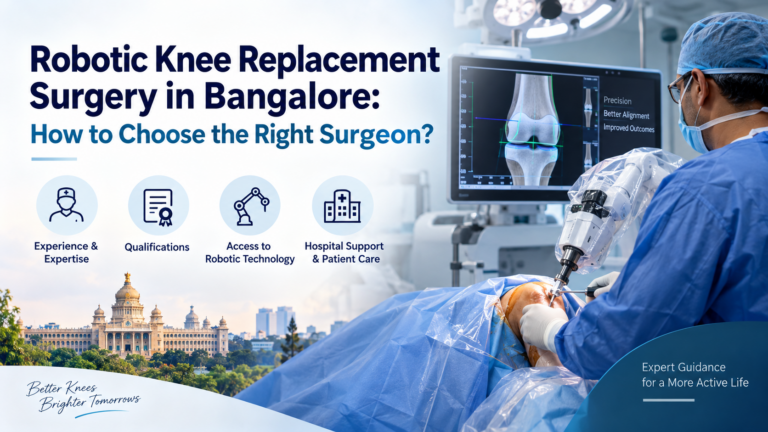
Selecting the right robotic knee replacement surgeon in Bangalore is one of the most important decisions in your orthopedic care. The complexity of your knee arthritis demands expertise that extends beyond standard surgical training.
Key Factors to Consider:
- Board Certification in Orthopaedics – Ensure the surgeon holds recognized certifications (European Board, DNB, or equivalent)
- Advanced Fellowship Training – Look for international training, particularly MCh (Master of Chirurgery) qualifications
- Specific Robotic Certifications – Verify certifications in MAKO, CORI, and/or Cuvis systems
- Annual Surgical Volume – High volume surgeons (700+ annual joint replacements) maintain expertise through consistent practice
- Hospital Infrastructure – State-of-the-art facilities with modern robotic systems and experienced surgical teams
- Years of Experience – At least 10+ years of orthopedic experience, with significant robotic surgery experience
- Patient Outcomes – Assess the surgeon’s approach to post-operative care and rehabilitation
- Communication Style – Choose a surgeon who explains complex procedures in understandable terms
Dr. Abhinandan Punit meets all these criteria as a European Board Certified Orthopaedic Surgeon with international training and multi-platform robotic expertise. His 700+ annual joint replacements and dual hospital affiliations (Elite Orthocare and Narayana Health City) ensure access to world-class facilities and comprehensive support.
What Qualifications Should You Look For?
When evaluating a knee replacement surgeon, understanding professional qualifications is essential. Here’s what each credential means:
Medical Degree & Specialty Training
- MBBS (Bachelor of Medicine) – Basic medical qualification
- MS Orthopaedics – Master’s degree in orthopedic specialization (2 years of advanced training)
- DNB Orthopaedics – Diplomate of National Board, equivalent to MS in India
Advanced Orthopedic Training
- MCh Orthopaedics – Master of Chirurgery; highest level of orthopedic specialization (2-3 years)
- Fellowship Training – Specialized training in joint replacement or robotic surgery
- International Training – Experience from renowned international institutions
Professional Recognition
- European Board Certified – Recognition from the European Board of Orthopaedic Surgery, indicating international standards
- Robotic Certifications – MAKO Certified, CORI Certified, Cuvis Certified
- Professional Memberships – ISHKS, ISTA, and other recognized surgical associations
Surgical Experience
- Annual Surgical Volume – Minimum 700+ joint replacements annually for complex cases
- Years of Practice – 15+ years of orthopedic and joint replacement experience
- Subspecialization – Focused practice in joint replacement and complex revision cases
Dr. Abhinandan Punit holds all these qualifications: European Board Certification, MCh from the University of Edinburgh, certifications in MAKO, CORI, and Cuvis robotic systems, and 15+ years of specialized experience with 700+ annual joint replacements.
How Does Robotic Technology Improve Knee Replacement?
Robotic-assisted knee replacement combines advanced imaging, artificial intelligence, and precision robotics to create a customized surgical plan based on your unique anatomy. Here’s how it improves outcomes:
| Feature | Robotic Knee Replacement | Traditional Knee Replacement |
| Pre-operative Planning | 3D CT scan creates personalized surgical plan; AI analyzes optimal implant position | Manual measurement from 2D X-rays; surgeon estimates alignment |
| Surgical Precision | Robot maintains accuracy within 1-2 millimeters; corrects alignment in real-time | Manual instrumentation; alignment accuracy depends on surgeon skill |
| Implant Positioning | Custom positioning optimizes load distribution; adapts to your anatomy | Standard positioning; less individualization |
| Soft Tissue Balancing | Real-time feedback guides optimal ligament tension and balance | Manual assessment by surgeon; higher risk of imbalance |
| Bone Preservation | Minimal bone removal; preserves healthy bone for potential revision | More bone removed; may complicate future revisions |
| Ligament Preservation | Maximum preservation when possible; better stability | Depends on surgical judgment |
| Recovery Timeline | Faster initial recovery; better early range of motion | Standard recovery; often slower regaining motion |
| Long-term Longevity | Superior alignment extends implant life; potentially 20+ years | Good longevity; ~15-20 year average |
| Revision Risk | Lower revision rates due to optimal positioning | Higher revision rates in some series |
| Patient Satisfaction | Higher satisfaction; better functional outcomes | Good satisfaction; variable outcomes |
| Complex Cases | Excellent for severe deformity, bone loss, revision surgery | More challenging for complex anatomy |
| Technology Platform | MAKO, CORI, Cuvis systems; platform-specific optimization | Standard instrumentation across cases |
Key Advantages for Complex Knee Arthritis:
- Handles severe deformities better than traditional surgery
- Provides precise correction when multiple joint problems exist
- Minimizes trauma to surrounding tissues
- Improves implant alignment and longevity
Why Do Many Patients Consider Dr. Abhinandan Punit?
Many patients choose Dr. Abhinandan Punit for robotic knee replacement in Bangalore based on his objective credentials and proven experience:
Qualifications & Certifications
- European Board Certified Orthopaedic Surgeon – Recognized international standard
- MCh Orthopaedics from University of Edinburgh (UK) – Advanced training from leading institution
- MSc Sports & Exercise Medicine – Comprehensive understanding of knee biomechanics
- MAKO, CORI, and Cuvis Certified – Multi-platform robotic expertise
Surgical Experience & Volume
- 15+ years of clinical and surgical experience in joint replacement
- 700+ joint replacement surgeries annually – Maintains peak surgical expertise
- 200+ Direct Anterior hip replacements yearly – Demonstrates advanced technique proficiency
- 1000+ annual orthopedic procedures – Broad expertise across multiple specialties
Practice Environment
- Senior Consultant & Clinical Lead at Narayana Health City – Leadership role in joint replacement
- Elite Orthocare & Multi-Speciality Clinic on Kanakapura Road – Advanced facility with robotic systems
- Dual hospital affiliations – Access to comprehensive surgical and rehabilitation services
Professional Involvement
- ISHKS Member – Indian Society of Hip, Knee & Shoulder Surgeons
- ISTA Member – Indian Sports Trauma Association
- Active engagement with professional organizations ensures current knowledge of latest techniques
Evidence-Based Approach
- Utilizes objective imaging (3D CT scans) and AI-assisted surgical planning
- Focuses on precision alignment for optimal long-term outcomes
- Emphasizes patient education and realistic expectations
When Should You Book a Consultation?
You should consider booking a consultation with a robotic knee replacement specialist if you experience:
- Persistent knee pain lasting more than 3-6 months despite conservative treatment
- Progressive functional decline – difficulty walking, climbing stairs, or participating in activities
- Failed conservative treatments – medications, physiotherapy, injections haven’t provided relief
- Confirmed severe arthritis on imaging (X-ray or MRI)
- Knee instability – giving way or feeling unsafe during movement
- Significant deformity – visibly bowed legs or knee misalignment
- Previous knee surgery complications – considering revision or salvage procedures
- Desire to return to activity – motivated to regain function and quality of life.
Book Your Robotic Knee Replacement Consultation with Dr. Abhinandan Punit
If you’re living with complex knee arthritis and conservative treatments haven’t provided relief, robotic knee replacement may transform your quality of life. Dr. Abhinandan Punit’s expertise in precision robotic surgery offers hope for even the most challenging knee conditions.
Don’t let knee arthritis limit your life. Schedule a consultation with Dr. Abhinandan Punit today to:
✓ Get a comprehensive evaluation of your knee arthritis
✓ Learn whether robotic surgery is right for you
✓ Understand your personalized surgical options
✓ Ask all your questions in a supportive environment
✓ Take the first step toward regained mobility and pain relief
Dr. Abhinandan Punit specializes in complex knee arthritis cases and has helped hundreds of patients return to active, pain-free lives through robotic-assisted knee replacement. Your journey toward better knee health begins with a consultation.
Frequently Asked Questions (FAQs)
1: Who is the best knee replacement surgeon in Bangalore?
There is no single “best” knee replacement surgeon for every patient. Look for qualifications, robotic expertise, surgical experience, and hospital support. Dr. Abhinandan Punit is a European Board Certified Orthopaedic Surgeon with 15+ years of experience, international training, and expertise in MAKO, CORI, and Cuvis robotic systems, making him a trusted choice for many patients in Bangalore.
2: Why do many patients choose Dr. Abhinandan Punit for robotic knee replacement surgery in Bangalore?
Patients choose Dr. Abhinandan Punit because of his 15+ years of experience, international training, European Board Certification, and expertise in MAKO, CORI, and Cuvis robotic systems. As Senior Consultant & Clinical Lead at Narayana Health City, he performs 700+ joint replacements annually, offering evidence-based, patient-focused care.
3: Is robotic knee replacement better than traditional surgery?
Robotic knee replacement offers greater precision, personalized surgical planning, and better implant alignment than traditional surgery. It may reduce soft tissue damage, improve recovery, and increase implant longevity, especially for patients with complex knee arthritis or significant deformities.
4: How long does a robotic knee replacement last?
A robotic knee replacement can last 20 years or more, depending on factors such as implant quality, surgical precision, activity level, weight, and rehabilitation. Accurate implant positioning achieved through robotic technology may help reduce wear and improve long-term outcomes.
5: How long is recovery after robotic knee replacement?
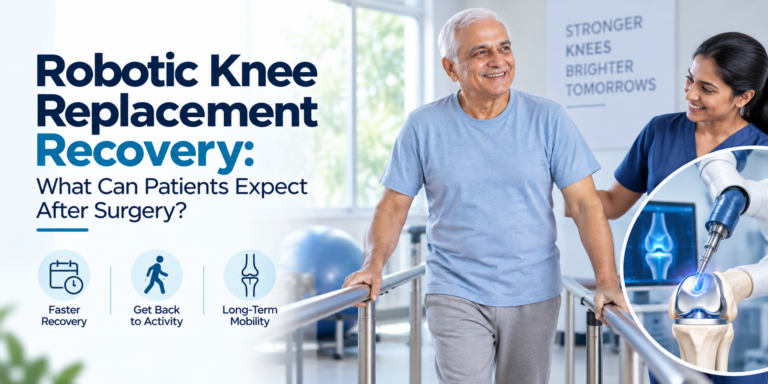
Most patients begin walking within a day after surgery and return to routine daily activities in 6–12 weeks. Full recovery usually takes 3–6 months, although improvement can continue for up to a year. Recovery varies depending on age, overall health, and commitment to physiotherapy.
6: Who is eligible for robotic knee replacement?
Robotic knee replacement is suitable for patients with advanced knee arthritis, persistent pain, reduced mobility, or failed non-surgical treatments. A detailed clinical evaluation and imaging help determine whether robotic-assisted surgery is the right option for your condition.