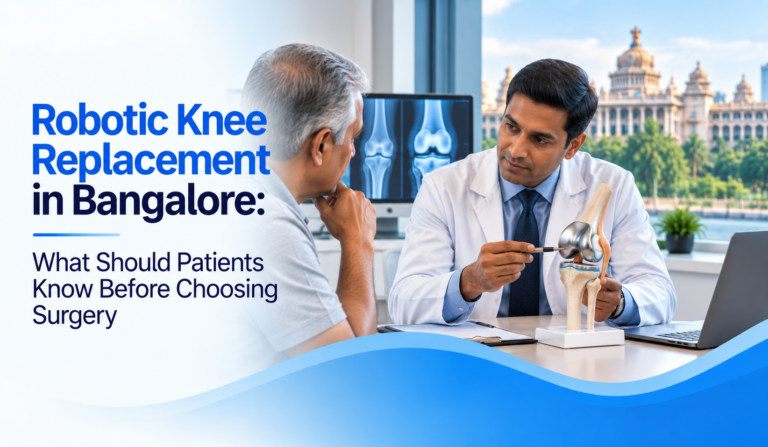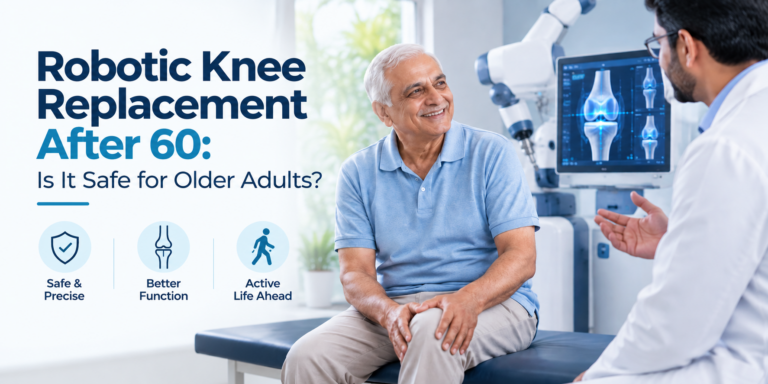

Robotic knee replacement in Electronic City, Bangalore is an option for patients considering knee replacement surgery for significant knee joint damage. Before choosing surgery, patients should understand the procedure, recovery, risks, and treatment costs.
Dr. Abhinandan Punit, an Orthopaedic and Robotic Joint Replacement Surgeon in Electronic City Bangalore, has 15+ years of experience and 6,000+ orthopaedic surgeries. He evaluates each patient’s condition and treatment needs before recommending an appropriate surgical approach.
What Is Robotic Knee Replacement?
Robotic knee replacement is a form of knee replacement surgery in which computer-assisted technology helps the surgeon plan and perform specific parts of the procedure. It can assist with assessing knee anatomy, planning implant positioning, and guiding bone preparation. The surgeon remains responsible for the procedure and makes the clinical decisions throughout surgery.
Patients considering treatment can learn more about robotic knee replacement surgery in Bangalore before making a decision.
How Does Robotic-Assisted Knee Replacement Work?
Robotic-assisted knee replacement combines the surgeon’s clinical judgment with computer-guided technology. Before surgery, the surgeon reviews the patient’s knee anatomy and imaging to develop an appropriate surgical plan. During the procedure, the technology provides guidance while the surgeon performs the required surgical steps.
The process generally involves:
- Reviewing the patient’s knee anatomy and imaging.
- Creating a computer-assisted surgical plan.
- Planning implant positioning and bone preparation.
- Using technology to guide specific surgical steps.
- Checking the planned alignment during the procedure.
- Completing the knee replacement under the surgeon’s control.
What Should Patients Know Before Robotic Knee Surgery?
Patients should understand that robotic technology is a surgical tool, not a replacement for the surgeon. The procedure still involves knee replacement surgery and requires proper medical assessment, preparation, anaesthesia, post-operative care, and rehabilitation.
Before surgery, patients should understand:
- Why knee replacement surgery has been recommended.
- How robotic assistance will be used during their procedure.
- What type of implant is planned.
- What the expected hospital stay may involve.
- What rehabilitation will be required.
- What restrictions may apply during recovery.
- What possible complications should be discussed.
What Happens Before Robotic Knee Replacement Surgery?
Preparation begins with a detailed medical and orthopaedic assessment. The surgeon reviews symptoms, medical history, previous treatments, physical findings, and relevant imaging. Other medical conditions may also need evaluation before surgery.
Patients may be asked to:
- Provide previous medical and surgical records.
- Complete recommended blood tests and investigations.
- Undergo imaging of the knee when required.
- Review current medications with the medical team.
- Discuss anaesthesia and medical clearance.
- Understand the planned rehabilitation programme.
- Arrange support at home after discharge.
Good preparation can help patients understand what to expect during the surgical and recovery process.
What Happens During Robotic Knee Replacement Surgery?
During robotic-assisted knee replacement, the surgeon follows the planned surgical approach while using computer-assisted technology for guidance. The damaged portions of the knee are prepared, and the replacement components are positioned according to the surgical plan.
The exact surgical technique can vary depending on the patient’s knee condition, anatomy, implant system, and surgeon’s approach. Patients should ask their surgeon how robotic technology will specifically be used in their procedure.
What Is Recovery Like After Robotic Knee Replacement?
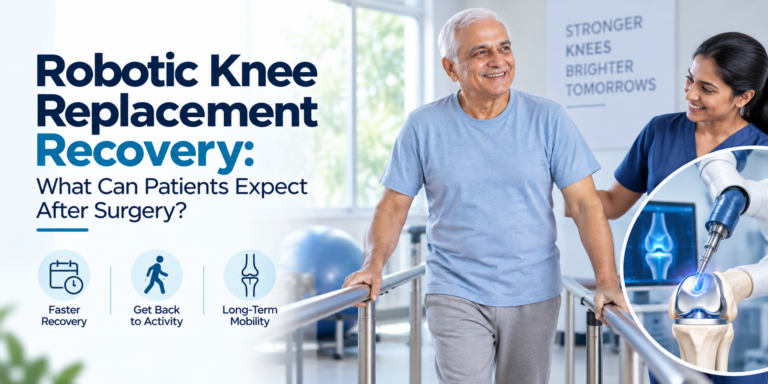
Recovery after robotic knee replacement varies between patients. Many patients begin assisted movement soon after surgery when medically appropriate. Physiotherapy then focuses on improving knee movement, muscle strength, balance, walking ability, and independence.
Recovery commonly involves:
- Early assisted movement.
- Progressive physiotherapy.
- Knee mobility exercises.
- Strengthening exercises.
- Gradual increase in walking.
- Follow-up appointments.
- Home exercises as advised.
Patients can read more about robotic knee replacement recovery to understand the recovery process in greater detail.
What Are the Risks of Robotic Knee Replacement?
Robotic assistance does not eliminate the risks associated with knee replacement surgery. Possible complications can include infection, bleeding, blood clots, stiffness, nerve or blood vessel injury, persistent pain, and implant-related problems.
The actual risks vary according to the patient’s health, medical history, knee condition, and surgical circumstances. Your surgeon should explain the potential risks and how they are managed before you consent to surgery.
What Are the Limitations of Robotic Knee Surgery?
Robotic knee surgery has some practical limitations. It requires specialised equipment and trained medical teams, and it may not be appropriate for every patient or every knee condition. The technology also does not guarantee a particular recovery time or surgical outcome.
Patients should therefore evaluate the surgeon, hospital, treatment plan, rehabilitation support, and overall medical care, rather than choosing a procedure based only on robotic technology.
How Should You Choose a Robotic Knee Replacement Surgeon in Bangalore?
Patients should look beyond the availability of robotic technology when selecting a surgeon. Consider the surgeon’s orthopaedic qualifications, knee replacement experience, robotic-assisted surgery experience, hospital facilities, rehabilitation support, and approach to individual treatment planning.
It is also important to ask who will perform the surgery, where the procedure will take place, what post-operative care is available, and how follow-up will be managed.
Patients can read more about how to choose a robotic knee replacement surgeon in Bangalore before making their decision.
What Is the Success Rate of Robotic Knee Replacement Surgery?
Robotic knee replacement generally has high success and patient satisfaction rates, with many patients reporting reduced pain, improved mobility, and better knee function after surgery. However, outcomes vary from person to person and depend on factors such as the knee condition, surgical planning, implant selection, overall health, and rehabilitation. A surgeon can discuss the expected outcome based on your individual condition.
Why Consult Dr. Abhinandan Punit for Robotic Knee Replacement in Electronic City, Bangalore?
Dr. Abhinandan S. Punit is a Senior Consultant and Clinical Lead in Joint Replacement and an Orthopaedic and Robotic Joint Replacement Surgeon in Bangalore. He has 15+ years of clinical and surgical experience and has performed 6,000+ orthopaedic surgeries.
His qualifications include MS Orthopaedics, DNB Orthopaedics, MCh Orthopaedics from the University of Edinburgh, and MSc Sports & Exercise Medicine from the University of South Wales. His practice focuses on joint replacement, robotic-assisted orthopaedic procedures, knee conditions, and sports medicine.
Dr. Abhinandan Punit practices at Narayana Health City, Bangalore, including the Electronic City area, and Elite Orthocare & Multi-Speciality Clinic on Kanakapura Road. Patients can learn more about Dr. Abhinandan Punit and explore robotic knee replacement in Electronic City.
Conclusion: What Should You Know Before Choosing Robotic Knee Replacement?
Robotic knee replacement involves more than choosing a technology. Patients should understand the planned procedure, surgical preparation, possible risks, recovery requirements, rehabilitation, costs, and the experience of the surgeon performing the operation. A detailed consultation is important before making a final decision.
Dr. Abhinandan S. Punit, an Orthopaedic and Robotic Joint Replacement Surgeon in Bangalore with 15+ years of experience and 6,000+ orthopaedic surgeries, provides individualised assessment and treatment planning for patients considering knee replacement. Patients in Electronic City, Bangalore, can book a consultation with Dr. Abhinandan Punit to discuss their symptoms and treatment options.
Frequently Asked Questions About Robotic Knee Replacement
Is robotic knee replacement painful?
Some pain and discomfort are expected after robotic knee replacement, especially during the early recovery period and physiotherapy. Pain management may include prescribed medicines, ice, movement, and rehabilitation. Discomfort usually improves as healing progresses. Severe, persistent, or worsening pain should be discussed with the treating surgeon.
What are the latest advancements in Robotic Knee Surgery?
Recent advancements include AI-assisted planning, imageless robotic systems, personalized alignment, and real-time surgical guidance. These technologies help surgeons plan procedures more precisely and tailor treatment to individual knee anatomy while keeping the surgeon in control of the operation.
How long does recovery take after robotic knee replacement?
Recovery varies between patients. Many patients begin assisted movement soon after surgery when medically appropriate, followed by progressive physiotherapy. Walking and daily activities generally improve gradually, while strength and flexibility may continue developing for several months. Recovery depends on overall health, fitness, knee condition, and rehabilitation progress.
What should I ask my surgeon before robotic knee replacement?
Ask why knee replacement is recommended, how robotic technology will be used, which implant is planned, what risks apply to your condition, how long recovery may take, and what rehabilitation will involve. You can also ask about hospital care, follow-up appointments, activity restrictions, and the overall treatment plan.
Which doctor should I consult for robotic knee replacement in Electronic City?
Dr. Abhinandan Punit is an Orthopaedic and Robotic Joint Replacement Surgeon in electronic city Bangalore with 15+ years of experience and 6,000+ orthopaedic surgeries. Patients in Electronic City, Bangalore can consult him for evaluation and treatment planning for robotic knee replacement.