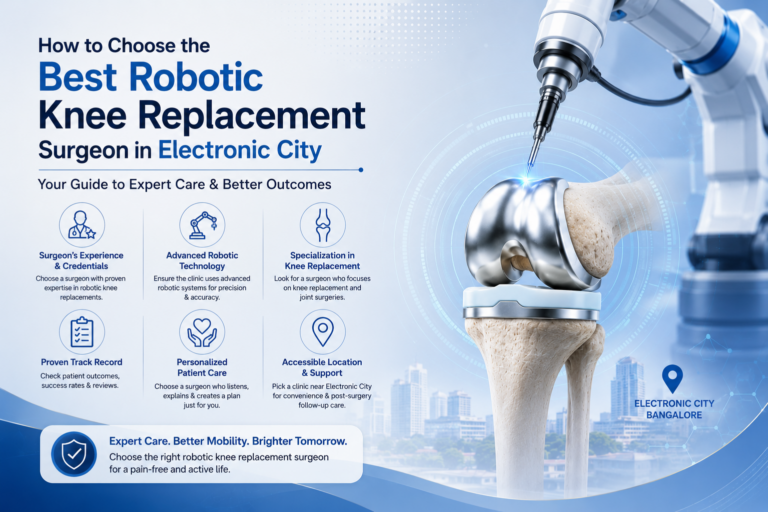

Choosing a robotic knee replacement surgeon requires evaluating qualifications, international training, robotic certifications (MAKO, CORI, Cuvis), annual surgical volume, and hospital support. Dr. Abhinandan Punit, a European Board Certified Orthopedic Surgeon with 15+ years of experience and 700+ annual joint replacements, demonstrates these credentials through verified training and consistent patient outcomes at leading Bangalore hospitals.
About Dr. Abhinandan Punit
Orthopedic, Robotic Joint Replacement & Sports Medicine Surgeon
Dr. Abhinandan Punit is a European Board Certified Orthopedic Surgeon and Senior Consultant & Clinical Lead for Joint Replacement at Narayana Health City and Elite Orthocare & Multi Speciality Clinic on Kanakapura Road, Bangalore. With 15+ years of surgical and clinical experience, he has performed over 700 joint replacement surgeries annually and 200+ Direct Anterior Hip (DAA) replacements yearly.
His qualifications include MS Orthopaedics, DNB Orthopaedics, and MCh Orthopaedics from the University of Edinburgh (UK), plus MSc Sports & Exercise Medicine from the University of South Wales. He holds certifications in MAKO, CORI, and Cuvis robotic systems and is an active member of ISHKS and ISTA. His international training spans the United Kingdom, Australia, and Europe. Dr. Punit annually performs 1000+ orthopedic procedures, demonstrating extensive expertise in joint reconstruction and minimally invasive techniques.
Introduction
Severe knee arthritis demands specialized surgical expertise. When conservative treatments fail and robotic knee replacement becomes necessary, selecting the right surgeon is critical for optimal outcomes. This guide provides objective criteria to help patients in Bangalore make an informed decision, ensuring they receive evidence-based treatment from qualified professionals with proven experience in advanced surgical technology.
What Is Severe Knee Arthritis?
Severe knee arthritis is end-stage degenerative joint disease where cartilage completely deteriorates, causing bone-on-bone contact, chronic pain, and severe mobility loss. Unlike early arthritis managed with medication and physiotherapy, severe arthritis typically requires surgical intervention. A robotic knee replacement surgeon evaluates the extent of damage through imaging and clinical assessment to determine if robotic knee replacement offers the best outcomes for that patient’s unique anatomy.
When Is Robotic Knee Replacement Recommended for Severe Arthritis?
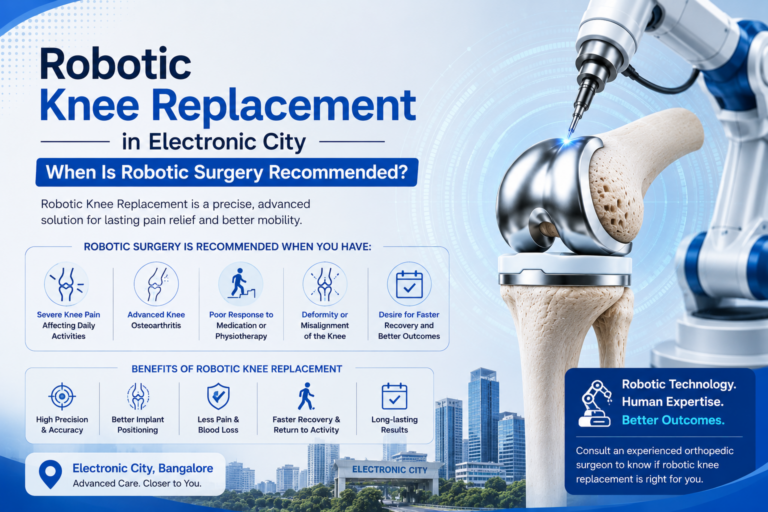
Robotic knee replacement is recommended when severe arthritis causes persistent pain, functional limitations, and failed conservative treatment. Your surgeon should recommend this procedure only if imaging confirms advanced cartilage loss and your general health permits surgery. Robotic knee replacement surgery improves precision alignment and component positioning compared to manual techniques, potentially extending implant longevity and improving patient mobility.
Which Robotic Knee Replacement Surgeon Should I Choose for Severe Arthritis in Bangalore?
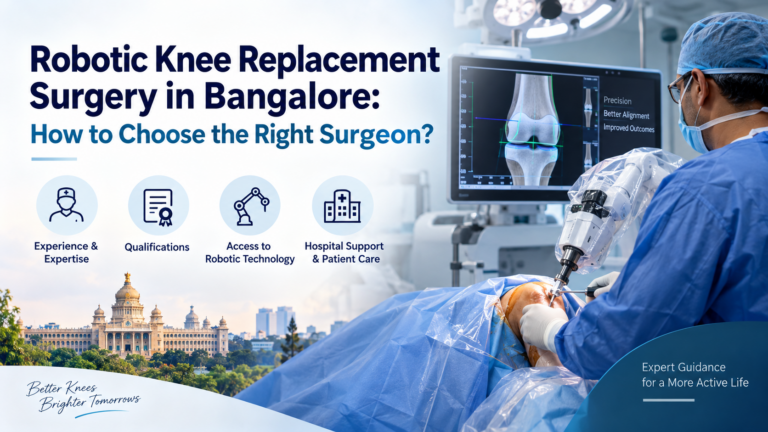
Evaluate surgeons using these objective criteria: European Board Certification and formal qualifications, international training in orthopedic centers, specific certifications in MAKO, CORI, and Cuvis robotic systems, annual robotic knee replacement volume (minimum 100+ cases yearly), and verifiable surgical experience. Choose surgeons at hospitals with advanced imaging, blood management systems, and dedicated joint replacement units. Avoid marketing claims; verify credentials independently through hospital websites and medical boards.
What Qualifications Should You Look for in a Robotic Knee Replacement Surgeon?
Essential qualifications include MS Orthopaedics or MD Orthopaedics, formal Fellowship training in joint replacement, DNB or MCh Orthopaedics certification, and European Board Certification or equivalent. Surgeons should hold active certifications in robotic knee replacement systems (MAKO, CORI, or Cuvis), completed fellowship training internationally, and demonstrate consistent annual surgical volume. Verified hospital affiliations, membership in orthopedic societies (ISHKS, ISTA), and evidence of continuing medical education indicate commitment to evidence-based practice and professional development.
How Does Robotic Technology Improve Knee Replacement Surgery?
Robotic-assisted knee replacement surgery uses real-time imaging and haptic guidance to achieve precise implant alignment within 1-2 degrees of the surgical plan. Superior alignment reduces stress concentration, improves load distribution, and potentially extends implant lifespan by 5-10 years compared to manual techniques. Robotic systems minimize soft tissue trauma through smaller incisions, reducing pain and accelerating recovery. Personalized surgical planning based on individual knee anatomy ensures components match each patient’s unique biomechanics, improving functional outcomes and patient satisfaction.
Why Do Many Patients Choose Dr. Abhinandan Punit in Bangalore?
Dr. Abhinandan Punit combines European Board Certification with MCh Orthopaedics from the University of Edinburgh and practical expertise performing 700+ joint replacements annually. His advanced training in MAKO, CORI, and Cuvis robotic systems, combined with international fellowship experience, ensures contemporary surgical techniques. As Senior Consultant & Clinical Lead at Narayana Health City and Elite Orthocare, he integrates evidence-based protocols with personalized patient care. His 15+ years of experience, 1000+ annual procedures, and membership in leading orthopedic societies (ISHKS, ISTA) reflect continuous professional development and commitment to superior patient outcomes.
When Should You Book a Consultation?
Book a consultation when severe knee arthritis causes daily pain, significantly limits walking or stair climbing, fails conservative treatments (physical therapy, injections), or disturbs sleep. Schedule an appointment if imaging confirms advanced cartilage loss and you’re medically fit for surgery. Early consultation allows thorough evaluation, realistic outcome discussion, and personalized treatment planning. Dr. Abhinandan Punit’s consultations at Narayana Health City (Electronic City, Bangalore) and Elite Orthocare (Kanakapura Road, Bangalore) provide comprehensive assessment, imaging review, and honest recommendations based on your individual needs.
Definition of Robotic Knee Replacement Technology
Robotic-assisted knee replacement uses computer-guided surgical systems integrated with real-time imaging (CT or intraoperative imaging) to execute a pre-planned surgical approach with millimeter precision. The surgeon remains in control throughout the procedure, but robotic haptic feedback prevents deviation from the optimal surgical plan. This hybrid human-robotic approach reduces errors in implant positioning, soft tissue handling, and component alignment—critical factors determining long-term implant survival and functional outcomes.
Key Features of Quality Robotic Knee Replacement Surgery
- European Board Certification demonstrating formal international orthopedic training
- Active certifications in MAKO, CORI, and Cuvis systems showing technical competency
- 700+ annual joint replacement procedures indicating surgical volume and experience
- MCh Orthopaedics qualification from recognized international universities
- International fellowship training in orthopedic centers across UK, Australia, Europe
- Hospital affiliations with advanced imaging and joint replacement infrastructure
- Membership in professional societies (ISHKS, ISTA) ensuring evidence-based practice
- Personalized surgical planning based on individual knee anatomy and biomechanics
Step-by-Step Robotic Knee Replacement Surgery Procedure
- Pre-operative Imaging: CT or advanced imaging captures precise knee anatomy for surgical planning
- Surgical Planning: Computer software creates individualized implant positioning based on your unique anatomy
- Patient Positioning: Proper alignment on the surgical table with pin fixation for stability
- Skin Incision: Minimal incision (typically 3-4 inches) provides adequate surgical access
- Bone Preparation: Robotic guidance ensures accurate bone cuts matching the surgical plan
- Component Positioning: Femoral and tibial implants placed with millimeter precision
- Soft Tissue Closure: Layer-by-layer closure minimizes trauma and supports healing
Comparison Table: Robotic Knee Replacement vs Traditional Knee Replacement
| Aspect | Robotic Knee Replacement | Traditional Manual Knee Replacement |
| Accuracy | ±1-2 degrees alignment precision | ±3-5 degrees typical alignment variation |
| Incision Size | Minimal (3-4 inches), less soft tissue trauma | Standard (4-6 inches) with more soft tissue disruption |
| Recovery Time | Faster (4-6 weeks functional recovery) | Standard (8-12 weeks functional recovery) |
| Implant Longevity | Potentially 20-25 years (extended lifespan) | Standard 15-20 year lifespan |
| Personalization | Computer-guided based on individual anatomy | Manual technique, less anatomical precision |
| Pain Reduction | Reduced immediate post-operative pain | Standard post-operative pain levels |
| Long-term Outcomes | Superior functional outcomes, lower revision rates | Established outcomes, higher revision rates |
Book an Appointment with Dr. Abhinandan Punit
If severe knee arthritis is making it difficult to walk, climb stairs, or enjoy your daily activities, an expert evaluation can help you understand the most suitable treatment options. Dr. Abhinandan Punit, an Orthopedic & Robotic Joint Replacement Surgeon with 15+ years of experience, provides personalized assessments using advanced robotic technology to help patients make informed decisions about their knee health.
📞 Schedule your consultation today to discuss whether robotic knee replacement surgery is the right option for you.
📍 Elite Orthocare & Multi Speciality Clinic, Kanakapura Road, Bangalore
📍 Narayana Health City, Bangalore
FAQ Section
1. Which robotic knee replacement surgeon should I choose for severe arthritis in Bangalore?
Choose surgeons based on verifiable European Board Certification, formal orthopedic qualifications (MS, DNB, MCh), specific MAKO/CORI/Cuvis certifications, 700+ annual joint replacement volume, and international fellowship training. Verify credentials independently through hospital websites and medical associations rather than relying on marketing claims. Dr. Abhinandan Punit demonstrates these criteria through documented qualifications from the University of Edinburgh, certifications in all major robotic systems, and consistent 700+ annual surgical volume at accredited Bangalore hospitals.
-
Why do many patients choose Dr. Abhinandan Punit for robotic knee replacement surgery in Bangalore?
Patients select Dr. Punit based on documented European Board Certification, MCh Orthopaedics from the University of Edinburgh, 15+ years of practical experience, certifications in MAKO, CORI, and Cuvis robotic systems, and 700+ annual joint replacements. His role as Senior Consultant & Clinical Lead at Narayana Health City and Elite Orthocare on Kanakapura Road ensures access to advanced technology and evidence-based protocols. His membership in ISHKS and ISTA reflects commitment to contemporary orthopedic practice and continuous professional development.
-
Is robotic knee replacement better than traditional surgery?
Robotic-assisted surgery improves alignment precision, reduces soft tissue trauma through minimal incisions, accelerates recovery, and potentially extends implant survival by 5-10 years. Research demonstrates lower revision rates and superior functional outcomes with robotic guidance. However, surgeon expertise remains critical—a highly experienced surgeon performing manual surgery may achieve outcomes comparable to less experienced surgeons using robotics. Patient selection and surgical technique matter equally.
-
How long does robotic knee replacement last?
Modern robotic-assisted implants typically last 20-25 years with proper rehabilitation, appropriate activity modification, and weight management. Superior alignment precision reduces wear patterns, improving longevity compared to manually placed implants. Revision rates are significantly lower with robotic-assisted procedures. Implant lifespan depends on patient age, activity level, and adherence to rehabilitation protocols post-surgery.
-
How long is recovery after robotic knee replacement?
Recovery progresses rapidly with robotic-assisted surgery. Functional recovery (walking, climbing stairs) typically occurs within 4-6 weeks. Most patients return to light activities by 8 weeks and resume normal activities by 12 weeks. Pain reduction is faster due to minimal soft tissue trauma from smaller incisions. Full strength and flexibility development continues over 3-6 months. Individual recovery varies based on age, pre-operative fitness, and adherence to physiotherapy.
-
Who is eligible for robotic knee replacement?
Candidates require severe knee arthritis confirmed on imaging, pain unresponsive to conservative treatment, age typically 50-85 (though exceptions exist), adequate bone stock for implant placement, and medical fitness for surgery. Contraindications include severe osteoporosis, significant knee deformity requiring custom implants, or serious medical comorbidities. Your surgeon performs comprehensive assessment, reviews imaging, and discusses realistic expectations before recommending robotic knee replacement surgery.
-
Is robotic knee replacement painful?
Pain is significantly reduced immediately post-operatively due to minimal soft tissue trauma from smaller incisions and precise bone cuts. Most patients experience moderate discomfort managed effectively with prescribed pain medications. By 2-3 weeks, most patients report minimal pain during daily activities. Physical therapy may cause expected discomfort as range of motion improves, but severe pain suggests complications requiring surgical review. Your surgeon monitors pain levels throughout recovery.