
Hip replacements dislocate when the ball slips out of the socket of the artificial joint. This happens due to incorrect implant positioning, muscle weakness, or moving the hip beyond its safe range. Most dislocations occur within the first three months after surgery. With the right surgical technique and rehabilitation, the risk can be significantly reduced.
Quick Summary
- Hip replacement dislocation occurs in 1–3% of primary surgeries and up to 28% of revision cases.
- Implant malpositioning is the most common preventable cause of dislocation.
- Robotic hip replacement and Direct Anterior Hip Replacement may reduce dislocation risk.
- Most first-time dislocations can be treated without repeat surgery.
- Physiotherapy and muscle strengthening are central to long-term prevention.
Introduction
Hip replacement dislocation is one of the most serious hip replacement complications — and one of the most distressing for patients. Understanding why it happens, who is at risk, and how modern surgical techniques are reducing its incidence helps patients make informed decisions about their care and recovery.
What Is Hip Replacement Dislocation?
Dislocation occurs when the femoral head (ball) of the artificial implant completely separates from the acetabular cup (socket). Hip instability after replacement — where the joint feels loose or at risk of slipping — is a warning stage that may precede full dislocation. A dislocated artificial hip causes sudden, severe pain and an inability to bear weight, and requires prompt medical attention.
How Common Is Hip Replacement Dislocation?
Data from international joint registries, including the Australian Orthopaedic Association National Joint Replacement Registry and the National Joint Registry of England and Wales, show that dislocation occurs in approximately 1–3% of primary total hip replacements. The risk is considerably higher — ranging from 10% to 28% — following revision hip replacement, where the anatomy is often altered and tissue quality is diminished. Dislocation remains one of the leading causes of revision hip surgery globally.
Why Do Hip Replacements Dislocate?
Several factors contribute to hip replacement dislocation:
Implant malpositioning is the single most common cause. If the acetabular cup or femoral stem is placed outside the safe zone of inclination and anteversion, the ball can lever out of the socket during routine movements.
Muscle weakness and soft tissue imbalance — particularly weakness of the hip abductors — reduce joint stability. The muscles act as dynamic stabilisers; when they are weak or disrupted, the implant relies solely on its mechanical fit.
Falls are a leading cause of dislocation in the early post-operative period, particularly in older adults.
Patient factors such as previous hip surgery, neuromuscular disorders, cognitive impairment, and obesity all independently increase risk.
Implant wear in older prostheses reduces the effective head-to-neck ratio, narrowing the arc of safe movement before impingement and dislocation occur.
Revision surgery carries heightened risk because abductor muscles may be scarred or absent, and restoring correct implant orientation in an already-altered hip is technically more demanding.
Who Is at Higher Risk of Hip Replacement Dislocation?
Certain patient groups face a higher baseline risk:
- Older adults, particularly those over 70, due to reduced muscle mass and coordination.
- Patients with neurological conditions such as Parkinson’s disease or stroke-related weakness, which impair motor control.
- Those with a history of previous hip surgery, including prior hip replacement, fracture fixation, or osteotomy.
- Obese patients, where soft tissue bulk alters hip mechanics and implant positioning is technically more challenging.
- Patients with significant muscle weakness or prior damage to the hip abductor tendons.
- Anyone undergoing revision hip surgery, which carries a substantially higher dislocation rate than primary surgery.
Can Robotic Hip Replacement Reduce the Risk of Dislocation?
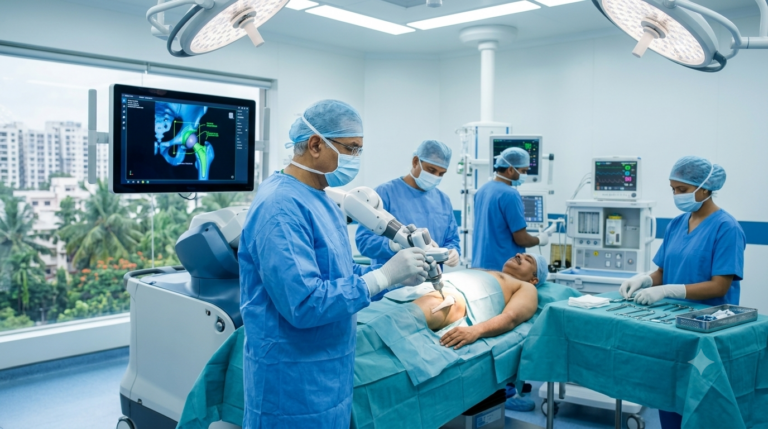
Robotic hip replacement has emerged as a tool to improve implant positioning accuracy. Conventional freehand cup placement is subject to patient positioning variables and surgeon-to-surgeon variability. Robotic systems — including image-guided and CT-based platforms — allow pre-operative planning of cup orientation and intra-operative real-time feedback to achieve the target position with greater consistency.
Current peer-reviewed evidence suggests robotic-assisted hip replacement improves cup placement accuracy compared to manual techniques. Several studies have reported fewer outliers in cup orientation when robotic guidance is used. However, long-term registry data confirming that this translates directly into lower dislocation rates remain emerging. Robotic systems also assist in restoring leg length and offset, which influence stability and patient-reported outcomes.
Robotic surgery does not eliminate all sources of dislocation — soft tissue factors, patient behaviour, and implant design all remain relevant.
Can Direct Anterior Hip Replacement Reduce Dislocation Risk?
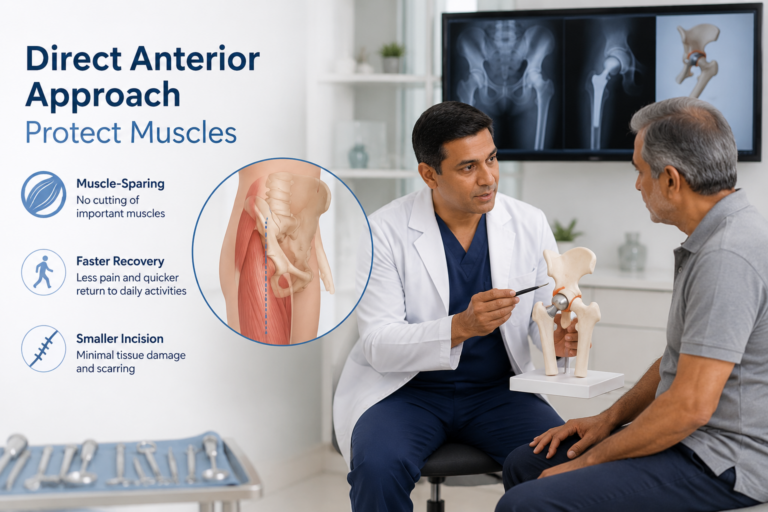
Direct Anterior Hip Replacement is a muscle-sparing approach that accesses the hip joint from the front without detaching the major hip muscles. Because the posterior capsule and the external rotator muscles are preserved, the approach is associated with a lower dislocation rate compared to posterior approaches — particularly in the early post-operative period.
Published evidence, including registry analyses and prospective studies, supports a lower early dislocation rate with the anterior approach. Patients undergoing Direct Anterior Hip Replacement also tend to require fewer post-operative movement restrictions.
The anterior approach is technically demanding and requires appropriate patient selection. It may not be suitable for all patients — particularly those who are obese or have had previous hip surgery.
What Should You Do If Your Artificial Hip Dislocates?
If you suspect your dislocated artificial hip, follow these steps immediately:
- Stop all movement. Do not attempt to walk or bear weight.
- Call for help. Ask someone to assist you or call emergency services.
- Stay still. Avoid any attempts to “click” the hip back into place yourself — this can cause further injury.
- Attend the nearest emergency department immediately. Dislocation is a medical emergency.
- Inform the treating team that you have a hip replacement and provide the name of your surgeon if possible.
- Reduction (repositioning of the joint) will typically be performed under sedation or anaesthesia.
- Contact your hip replacement surgeon as soon as possible after reduction for further assessment.
Can Hip Replacement Dislocation Be Prevented?
Evidence-based prevention strategies include:
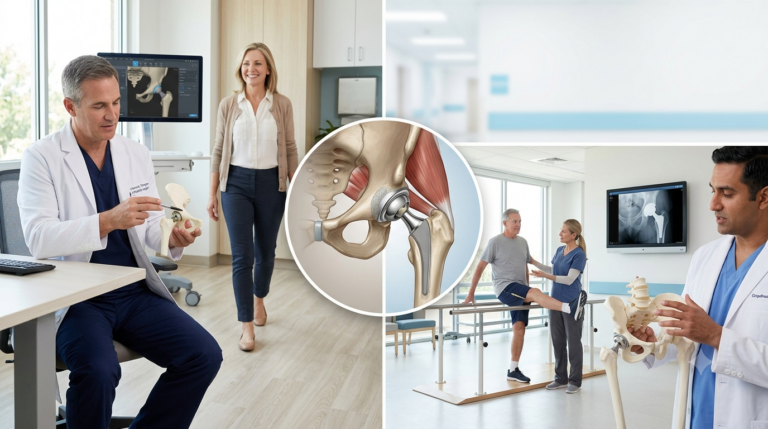
Physiotherapy: Structured pre-operative and post-operative physiotherapy strengthens the hip abductors and improves neuromuscular control, which are critical for joint stability.
Hip precautions: Avoiding extreme flexion, adduction, and internal rotation — particularly in the early weeks after a posterior approach — reduces dislocation risk. Your surgeon will advise which precautions apply to your specific approach.
Home safety: Removing trip hazards, using grab rails, and sleeping on a firm surface at an appropriate height reduce fall risk.
Muscle strengthening: Targeted abductor and core strengthening exercises, continued long term, support joint stability.
Weight management: Maintaining a healthy body weight reduces mechanical stress on the hip and assists with post-operative rehabilitation.
Compliance with rehabilitation: Completing the full course of hip replacement recovery as advised by your surgeon and physiotherapist is among the most effective prevention strategies available.
What Does Current Research Say?
The American Academy of Orthopaedic Surgeons (AAOS) and major international joint registries identify dislocation as one of the top causes of revision surgery after total hip replacement. Registry data consistently show that revision surgery carries a substantially higher dislocation rate than primary surgery, which has driven interest in surgical techniques and implant designs that reduce instability.
Current evidence supports the use of larger femoral head sizes (36 mm and above), dual-mobility cup constructs — particularly in high-risk patients — and anatomical restoration of hip offset and leg length. Dual-mobility cups, which feature a mobile polyethylene insert, have demonstrated significant reductions in dislocation rates in high-risk populations in multiple European and Australian registry analyses.
Both robotic hip replacement and Direct Anterior Hip Replacement have literature supporting improved accuracy of implant positioning, with evidence continuing to accumulate on their effect on long-term dislocation rates.
Hip Replacement With Stable Implant vs Hip Replacement With Recurrent Dislocation
| Outcome | Stable Hip Replacement | Recurrent Dislocation |
| Pain | Minimal to none at baseline | Persistent pain; acute severe pain at dislocation |
| Walking ability | Progressively improving | Impaired; may require aids long-term |
| Implant stability | Maintained within safe movement | Compromised; mechanical failure likely |
| Daily activities | Return to normal within weeks to months | Severely restricted; ongoing dependency |
| Need for further surgery | Unlikely | High probability of revision hip surgery |
| Recovery trajectory | Predictable, structured | Disrupted; recovery restarts after each event |
| Long-term outlook | Excellent in most cases | Guarded; depends on cause and revision outcome |
Warning Signs You Should Never Ignore
- Sudden, sharp hip pain accompanied by a “pop” or “clunk” sensation.
- Complete inability to bear weight after hip replacement.
- One leg appearing shorter or rotated outward compared to the other.
- Visible deformity around the hip joint or groin.
- Groin or buttock pain that is getting progressively worse over weeks.
- Persistent clicking or a sensation that the hip is “catching.”
- Swelling, warmth, or redness around the hip that does not resolve.
7 Ways to Reduce the Risk of Hip Replacement Dislocation
- Choose an experienced surgeon with high-volume practice in hip replacement and familiarity with anterior or robotic techniques where appropriate.
- Complete pre-operative physiotherapy to build hip muscle strength before surgery.
- Follow all post-operative hip precautions as directed — particularly in the first 12 weeks.
- Attend every physiotherapy session and complete home exercise programmes consistently.
- Remove fall hazards from your home before discharge: loose rugs, low chairs, and poor lighting are common culprits.
- Maintain a healthy body weight to reduce mechanical load on the implant.
- Attend all follow-up appointments — early detection of hip instability allows timely intervention before full dislocation occurs.
Frequently Asked Questions
How do I know if my hip replacement has dislocated?
A dislocated artificial hip typically causes sudden, severe pain in the groin or buttock, often accompanied by a “pop.” The affected leg may appear shorter than the other or rotated outward. You will be unable to stand or bear weight. This is a medical emergency — attend your nearest emergency department immediately.
Is hip dislocation an emergency?
Yes. A dislocated artificial hip requires prompt reduction — repositioning of the joint — which is performed under sedation or anaesthesia in a hospital setting. Do not attempt to manipulate the hip yourself. Delays in treatment can cause damage to surrounding nerves, blood vessels, and soft tissue.
Can I walk after a hip replacement dislocation?
No. Walking on a dislocated hip is not possible and would cause serious injury. You will be unable to bear weight on the affected leg. Emergency medical assistance is required, and transportation to hospital should not involve placing any load on the joint.
Can robotic surgery reduce dislocation risk?
Robotic hip replacement improves the accuracy of implant cup positioning, which is one of the primary causes of dislocation. Studies show robotic systems reduce outliers in cup orientation compared to manual techniques. Whether this directly reduces long-term dislocation rates is supported by emerging evidence; your surgeon can advise whether robotic surgery is appropriate for your individual anatomy and risk profile.
Can physiotherapy prevent another dislocation?
Physiotherapy is one of the most evidence-supported prevention strategies. Strengthening the hip abductor and core muscles improves dynamic joint stability. After a first dislocation, a structured rehabilitation programme — combined with addressing the underlying mechanical cause — significantly reduces the risk of recurrence in patients who do not require revision surgery.
Will I need revision surgery after a dislocation?
Not necessarily. Many first-time dislocations are successfully treated with closed reduction under sedation, followed by a period of bracing and rehabilitation. However, recurrent dislocation — typically defined as two or more events — usually requires revision hip surgery to correct the underlying cause, whether that is implant malpositioning, soft tissue failure, or implant wear.
About Dr. Abhinandan Punit — Hip Replacement & Revision Hip Surgery Specialist, Bangalore
Dr. Abhinandan Punit is a European Board Certified Orthopaedic Surgeon with an MCh in Orthopaedics and over 15 years of dedicated experience in adult hip reconstruction. He serves as Senior Consultant and Clinical Lead – Joint Replacement at Narayana Health City, and practices at Elite Orthocare & Multi Speciality Clinic, both located in Bangalore.
Dr. Punit performs over 700 joint replacement surgeries annually, including more than 200 Direct Anterior Hip Replacements each year — one of the highest-volume anterior hip practices in the region. He is a trained robotic joint replacement specialist with international fellowship training, enabling him to offer patients access to advanced techniques including robotic hip replacement for optimised implant positioning and stability.
His practice serves patients across Bangalore, including South Bangalore, Kanakapura Road, and Electronic City, as well as patients travelling from across India for revision hip replacement and complex reconstructive procedures.