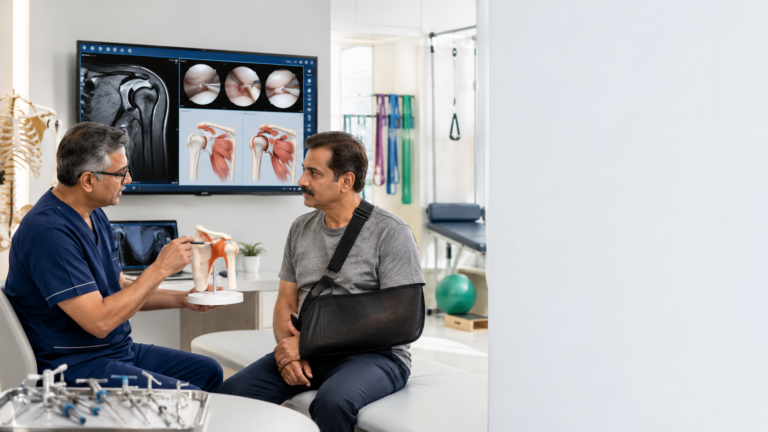

Most rotator cuff injuries can begin healing with rest, anti-inflammatory medications, and physical therapy. However, large tears, complete ruptures, or injuries that don’t improve after 6-12 weeks of conservative treatment often require surgery. Shoulder arthroscopy—a minimally invasive surgical approach—offers faster recovery and better outcomes than traditional open surgery, making it the preferred choice for surgical rotator cuff repair.
What Is a Rotator Cuff Injury?
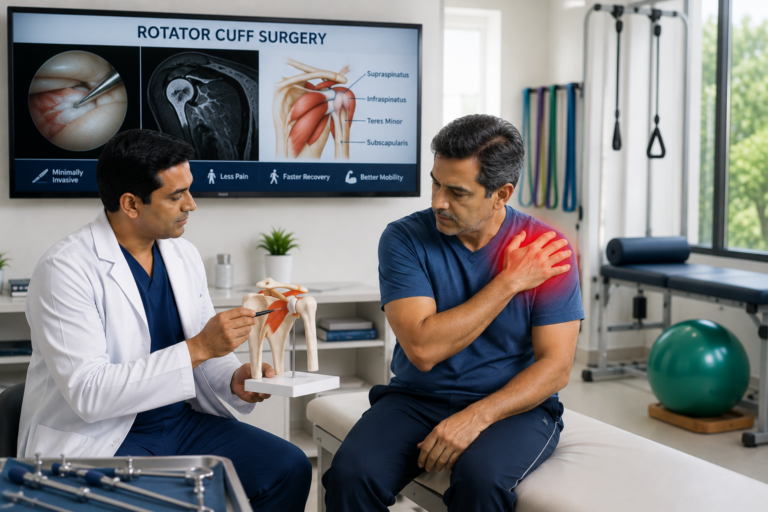
Your rotator cuff consists of four muscles and tendons that stabilize your shoulder joint and allow you to lift and rotate your arm. These muscles are: supraspinatus, infraspinatus, teres minor, and subscapularis.
A rotator cuff injury ranges from inflammation and tendinitis to partial tears and complete ruptures. Small tears may not cause immediate symptoms, while larger injuries create sharp pain, weakness, and loss of function.
The rotator cuff is constantly under stress. Unlike large joint stabilizers, these tendons have limited blood supply, making them prone to degeneration, especially after age 40. This is why rotator cuff problems are increasingly common with age.
What Causes a Rotator Cuff Injury?
Rotator cuff injuries develop through two main mechanisms:
Acute Traumatic Injury
- Heavy lifting or pulling motion
- Fall landing on outstretched arm
- Direct shoulder impact or collision
- Sudden overhead activity in sports
These injuries can tear the tendon completely, even in younger patients, and typically require surgical evaluation within days.
Gradual Degeneration (Most Common)
- Repetitive overhead activities (throwing, serving in tennis, painting)
- Poor shoulder mechanics and muscle imbalance
- Bone spurs impinging the tendon (subacromial impingement)
- Natural aging and decreased blood supply
- Previous shoulder injuries or instability
Chronic degeneration accounts for 80% of rotator cuff injuries. The tendon gradually weakens over months or years, often without a specific injury triggering pain.
Risk Factors
- Age over 40 (prevalence increases dramatically)
- Overhead athletes and laborers
- Diabetes (reduces healing capability)
- Smoking (impairs blood flow and healing)
- Previous shoulder dislocation
- Poor posture and muscle weakness
What Are the Symptoms of a Rotator Cuff Tear?
Rotator cuff injury symptoms vary depending on tear size, location, and chronicity.
Common Symptoms
Early Stage (Tendinitis)
- Mild shoulder pain, especially with overhead activities
- Discomfort at night, particularly when sleeping on the affected shoulder
- Stiffness upon waking
- Pain when reaching behind the back
Progressive Tear
- Sharp, constant pain even at rest
- Weakness when lifting or rotating the arm
- Difficulty raising the arm overhead
- Clicking or popping sensation
- Loss of normal shoulder strength and range of motion
Important Distinction
Many people with rotator cuff tears experience no pain—especially asymptomatic partial tears found incidentally on imaging. However, these can progress to symptomatic tears if left untreated.
Conversely, significant pain doesn’t always indicate a complete tear. Inflammation and small tears can be extremely painful, while some massive rotator cuff tears cause minimal discomfort.
How Is a Rotator Cuff Injury Diagnosed?
Diagnosis requires a combination of clinical examination and imaging.
Physical Examination
- Neer’s Test: Pain during arm elevation
- Hawkins Test: Pain when internally rotating the shoulder
- Drop Arm Test: Inability to lower arm smoothly (suggests complete tear)
- Strength Testing: Weakness in external rotation, abduction
- Range of Motion: Restricted active movement (but passive movement may be normal)
Imaging Studies
Ultrasound
- First-line imaging in many cases
- Real-time assessment of tendon movement
- No radiation; can be done in clinic
- Highly operator-dependent; less reliable than MRI
MRI (Magnetic Resonance Imaging)
- Gold standard for diagnosis
- Shows tear size, location, retraction
- Identifies fatty infiltration (indicates chronic, degenerated muscle)
- Guides surgical planning
- Cost: ₹8,000-15,000
X-Rays
- Identifies bone spurs
- Checks for arthritis
- Rules out fracture
- Often done first before advanced imaging
CT Scan
- Rarely needed; useful for complex cases with prior surgery
Why Imaging Matters for Treatment Decisions
The exact tear size, location, and muscle quality determine whether conservative or surgical treatment is appropriate. A 2cm tear in a 45-year-old with good muscle quality has different treatment than a 5cm tear in a 65-year-old with fatty infiltration.
Can Rotator Cuff Injuries Heal Without Surgery?
Yes, but only for specific injury types. The key variable is tear size.
Injuries That Heal Without Surgery
- Tendinitis and small partial tears (<1cm): 70-85% heal with conservative care
- Small full-thickness tears (1-2cm): 50-60% heal with appropriate treatment
- Traumatic injuries in younger patients: Higher healing potential due to better blood supply
The 6-12 Week Timeline
Most conservative treatment succeeds within this window:
- Weeks 1-3: Rest, anti-inflammatory medications, ice
- Weeks 3-6: Gentle passive and active-assisted range of motion
- Weeks 6-12: Progressive strengthening, return to functional activities
If imaging shows no improvement by 12 weeks, or if symptoms worsen, surgery becomes necessary.
When Conservative Treatment Fails
- Persistent pain interfering with daily activities
- No improvement in strength after 12 weeks of therapy
- Loss of function preventing work or essential activities
- Patient age and demands: Younger, active patients may choose earlier surgery
What Are the Non-Surgical Treatment Options?
Conservative rotator cuff treatment is structured and evidence-based, not passive.
1. Rest and Activity Modification
- Avoid overhead activities and heavy lifting
- Sleep on the unaffected shoulder
- Use a sling for 1-2 weeks in acute phase (not extended use)
- Gradual return to activity as tolerated
2. Anti-Inflammatory Medications
- NSAIDs (ibuprofen, naproxen): Reduce pain and inflammation
- Duration: 2-4 weeks typically
- Caution in patients with gastric ulcers or kidney disease
3. Corticosteroid Injections
- Reduces inflammation and pain temporarily
- Allows patients to participate in physical therapy
- Limitations: No more than 3 injections per year; effect wears off in weeks
- Success rate: 50-70% get significant relief (temporary)
4. Platelet-Rich Plasma (PRP) Injections
- Newer biologic approach using growth factors from patient’s own blood
- Promotes tissue healing
- Evidence: Mixed results; helpful in early-stage degenerative tears
- Cost: ₹15,000-30,000 per injection
- Multiple injections often needed
5. Physical Therapy (Most Important)
Physical therapy is the cornerstone of conservative treatment and must be structured:
Phase 1 (Weeks 1-4): Passive Motion
- Pendulum exercises
- Passive range of motion
- Pain management focus
Phase 2 (Weeks 4-8): Active Assisted Motion
- Gentle strengthening
- Scapular stabilization exercises
- Internal/external rotation work
Phase 3 (Weeks 8-12): Active Strengthening
- Progressive resistance exercises
- Functional movement patterns
- Sport or activity-specific training
Success depends on patient commitment—3 sessions per week minimum for 8-12 weeks.
6. Home Exercise Program
- Critical component of recovery
- Daily exercises beyond physical therapy sessions
- Consistency matters more than intensity
When Is Surgery Recommended?
Surgery is indicated when conservative treatment fails or the injury characteristics demand surgical intervention.
Absolute Indications for Surgery
- Complete rotator cuff tear causing functional loss in active patient
- Large tears (>3cm) that won’t heal with conservative care
- Traumatic tears in younger patients (<60 years)
- Fatty infiltration (chronic atrophy) visible on MRI
- Failed conservative treatment after 12 weeks with no improvement
Relative Indications (Consider Surgical Repair)
- Symptomatic partial tears not responding to 6-8 weeks of therapy
- Worker’s compensation cases requiring predictable, faster recovery
- Athletes requiring return to overhead sports
- Tear with significant retraction (tendon pulled away from bone)
Contraindications to Surgery
- Asymptomatic tears found incidentally (observe with imaging)
- Advanced shoulder arthritis (rotator cuff arthropathy)
- Irreparable tear with severe muscle atrophy and fatty infiltration
- Severe medical comorbidities making surgery too risky
What Happens During Rotator Cuff Surgery?
Pre-Operative Preparation
- Imaging Review: MRI determines tear size, location, and tissue quality
- Anesthesia Consultation: General anesthesia with regional nerve block for post-op pain control
- Surgical Planning: Surgeon determines approach and repair technique
The Surgical Procedure
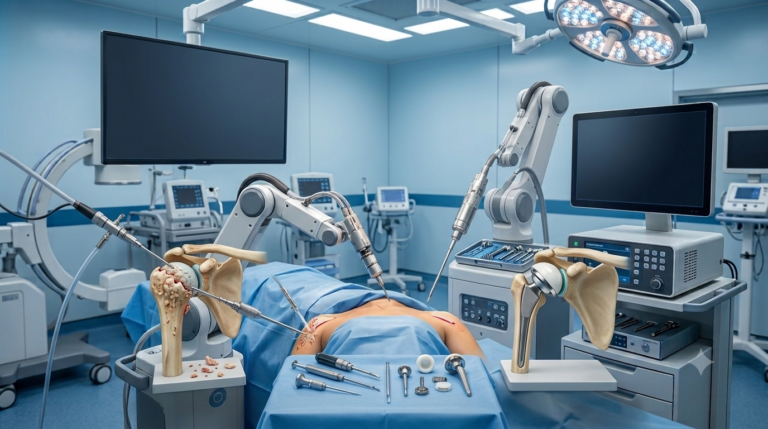
Shoulder Arthroscopy Approach (Most Common)
- Positioning: Patient placed on side or beach-chair position
- Portal Creation: 2-3 small incisions (5-10mm each) inserted for camera and instruments
- Inspection: Complete view of rotator cuff, biceps, and shoulder joint
- Debridement: Remove torn tissue edges and bone spurs
- Repair Technique:
- Anchor-Based Repair: Small metal or bioabsorbable anchors placed in bone
- Suture Placement: Sutures pass through tendon and anchor
- Knot Tying: Typically 2-3 rows of sutures for larger tears
- Testing: Surgeon verifies repair integrity
- Closure: Small sutures close skin incisions
Procedure Duration: 60-90 minutes depending on tear size
Rotator Cuff Surgery vs Delaying Treatment: Timing Matters
What Happens If You Delay Surgery?
Delaying necessary surgery has consequences that worsen over time.
Progression Table
| Timeline | Tissue Changes | Implications |
|---|---|---|
| At Diagnosis | Tear present; good muscle quality | High repair success rate (85-90%) |
| 3-6 Months Delay | Initial fatty changes visible; muscle atrophy begins | Success rate begins declining; harder repair |
| 6-12 Months Delay | Significant fatty infiltration (grade 1-2); muscle shrinkage | Success rate drops to 70-80%; repair more complex |
| 12+ Months Delay | Severe atrophy and fatty infiltration (grade 3-4); permanent changes | Success rate <50%; may become irreparable |
Why Timing Affects Repairability
Muscle Quality Matters
- Chronic tears develop fatty infiltration—permanent replacement of muscle tissue
- Once muscle becomes mostly fat, it cannot contract normally, even after repair
- This is why early surgery produces better functional outcomes
Tendon Retraction
- As tear sits untreated, the damaged tendon retracts (pulls away from bone)
- Larger retraction makes repair more difficult
- Retracted tendons may need special techniques (mobilization, transfers)
Tear Propagation
- Small tears often enlarge with time
- Larger repairs are harder and carry lower success rates
The Window of Opportunity
Ideal Timing: Surgery within 3-6 months of injury
- Minimal muscle changes
- Good tissue quality
- High repair success rate
Acceptable Timing: 6-12 months
- Some muscle changes but still reparable
- Reasonable success rate (70-80%)
Risky Timing: Beyond 12 months
- Significant permanent changes
- Lower success rates
- Possible irreparability
Rotator Cuff Recovery Timeline
Recovery is a structured process with predictable milestones.
Week-by-Week Recovery Guide
Weeks 0-2: Post-Op Protection
- Activity: Minimal motion only
- Sling Use: Continuous or most of the day
- Pain Level: 5-8/10, improving by day 7-10
- Physical Therapy: Passive range of motion only
- Work: Light desk work OK; no lifting
- Sleep: Sling during sleep; pain management challenging
Weeks 2-4: Early Motion
- Activity: Begin active-assisted range of motion
- Exercises: Pendulum, passive stretching, scapular activation
- Pain Level: 4-6/10
- Therapy Sessions: 2-3 per week
- Return to Work: Light office work; no manual labor
- Sleep: Often improves; may still use sling
Weeks 4-8: Active Motion
- Sling Use: Wean off (except in public/crowded areas)
- Exercises: Active motion without resistance; basic strengthening begins
- Pain Level: 2-4/10
- Range of Motion: Significant improvement; may reach functional levels
- Work: Modified duties; avoiding repetitive motions
- Activities: Gentle household activities OK
Weeks 8-12: Strengthening Phase
- Exercises: Progressive resistance with light weights (1-2kg)
- Pain Level: 1-3/10 or pain-free
- Therapy Focus: Muscle strengthening; return to function
- Work: Most people return to work (modified initially)
- Activity: Light recreational activities; no heavy lifting
- Goal: 50% normal strength
Weeks 12-16: Progressive Loading
- Exercises: Increased weight resistance; sport/activity-specific training
- Pain Level: Usually minimal
- Strength: 60-75% normal
- Return to Light Activities: Yes (golf, swimming, light throwing)
- Heavy Activity: Not yet
Months 4-6: Functional Return
- Strength: 75-90% normal
- Return to Heavy Work: Full duty (with caution)
- Return to Sports: Sport-specific training; throwing sports cautiously
- Exercise: Heavy strengthening; sport-specific movements
Months 6-12: Full Recovery
- Strength: 90-100% normal
- Return to All Activities: Unrestricted
- Timeline: Varies by individual; athletes may take 9-12 months
Factors That Affect Recovery Speed
- Age: Younger patients heal faster
- Tear Size: Larger tears take longer
- Tear Type: Complete tears take longer than partial
- Repair Quality: Secure repairs heal faster
- Patient Compliance: Therapy adherence is critical
- Comorbidities: Diabetes, smoking slow healing
Why Choose Dr. Abhinandan Punit for Rotator Cuff Injury Treatment in Bangalore?
Dr. Abhinandan Punit is an Orthopedic & Robotic Joint Replacement Surgeon with extensive expertise in shoulder arthroscopy and rotator cuff repair.
Dr. Punit’s Credentials
- 15+ years of orthopedic surgical experience
- 6,000+ surgeries performed across joint replacement and arthroscopy
- Specialized expertise in robotic-assisted and arthroscopic procedures
- Bangalore-based with offices at two major hospitals
Hospital Affiliations
- Elite Orthocare, Kanakapura Road, Bangalore
- Narayana Clinic, Electronic City, Bangalore
Both facilities are equipped with modern arthroscopic equipment and support protocols for optimal recovery.
Why Dr. Punit’s Approach Is Different
- Minimally Invasive Focus: Emphasis on arthroscopic repair for faster recovery
- Comprehensive Assessment: Detailed imaging analysis before surgical recommendations
- Patient Education: Clear explanation of options, expectations, and recovery timelines
- Evidence-Based Practice: Treatment protocols based on latest orthopedic literature
- Individualized Plans: Customized treatment for each patient’s tear characteristics and goals
Patient Benefits
- High success rate arthroscopic repairs
- Minimal post-operative pain
- Same-day discharge option
- Clear recovery expectations
- Experienced post-operative care team
Ready to Get Expert Shoulder Care? Book Your Consultation Today
Rotator cuff injuries don’t improve on their own. While conservative treatment works for some, delaying necessary surgery increases the risk of permanent muscle damage and irreparability.
Don’t let shoulder pain limit your life.
Dr. Abhinandan Punit has successfully repaired thousands of rotator cuff injuries using modern arthroscopic techniques. Whether your injury needs conservative treatment, advanced physical therapy, or surgical repair, Dr. Punit will create a personalized plan to restore your shoulder function and return you to pain-free activity.
What to Expect During Consultation:
- Detailed injury history and symptom review
- Comprehensive physical examination
- Review of imaging (or ordering MRI if needed)
- Clear explanation of treatment options
- Personalized recovery timeline
- Cost and logistics discussion
- Appointment scheduling if proceeding with treatment
Don’t delay. Early intervention often means simpler treatment, better outcomes, and faster recovery.
Frequently Asked Questions About Rotator Cuff Injury Treatment
Q1: Can a rotator cuff tear heal naturally without surgery or therapy?
Small partial tears (<1cm) sometimes stabilize with rest alone, but this is unreliable. Most tears require either structured physical therapy or surgery to prevent progression. Complete tears cannot heal on their own—the tendon won’t reattach to bone without surgical fixation. Even if a tear doesn’t worsen, leaving it untreated often results in permanent muscle atrophy (fatty infiltration), making later repair more difficult.
Q2: Do all rotator cuff tears need surgery?
No. Small partial tears and early-stage tendinitis typically respond to 6-12 weeks of conservative treatment. However, complete tears, large tears (>3cm), and injuries that don’t improve after 12 weeks of physical therapy usually benefit from surgery. Your surgeon will recommend surgery based on tear size, your age, activity level, and whether conservative treatment is working.
Q3: How painful is rotator cuff surgery?
Post-operative pain is usually moderate (4-5/10) for the first week, decreasing to mild (1-3/10) by weeks 3-4. Modern anesthesia techniques include regional nerve blocks that provide excellent pain control for the first 24-48 hours. Most patients manage pain with oral medication by week 2-3. The arthroscopic approach causes significantly less pain than open surgery because muscle isn’t cut.
Q4: How long is recovery after rotator cuff surgery?
Pain significantly improves within 4-6 weeks. Return to light activities (desk work, basic household tasks) typically occurs by 8-10 weeks. Full functional return takes 3-6 months depending on tear size and repair quality. Return to heavy lifting or overhead sports can take 6-12 months. Complete tissue healing takes approximately 12 weeks, but functional strength continues improving for 6 months.
Q5: Can I drive after rotator cuff surgery?
Not immediately. Most patients cannot drive safely for 4-6 weeks post-op due to pain, weakness, and restricted shoulder motion. Return to driving depends on pain levels, strength, and pain medication use (narcotic medications impair judgment). Discuss with your surgeon before driving; most recommend waiting until you can safely perform an emergency maneuver without pain.
Q6: Can physiotherapy repair a rotator cuff tear?
Physical therapy cannot repair a torn tendon—it cannot reattach torn tissue to bone. However, physical therapy can reduce pain, improve strength, and prevent progression in small tears and tendinitis. For complete tears or large tears, physical therapy alone typically doesn’t provide functional improvement and may mask underlying injury. PT is essential before and after surgical repair, but it’s a complement to surgery, not a replacement for necessary surgical repair.