
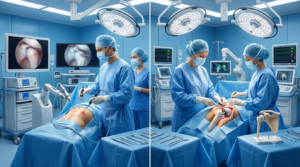
 The choice between shoulder arthritis debridement and shoulder replacement surgery depends on arthritis severity, age, activity level, and imaging findings. Debridement—arthroscopic cleaning and repair—works for mild to moderate arthritis in younger, active patients. Replacement is appropriate for severe bone-on-bone arthritis with failed conservative treatment. Your surgeon evaluates cartilage damage, bone structure, and functional goals to recommend the best approach.
Quick Summary
- Shoulder arthritis debridement is a joint-preserving procedure for mild to moderate arthritis.
- Shoulder replacement surgery is definitive treatment for severe, bone-on-bone arthritis.
- Debridement may delay replacement in selected patients; it cannot reverse advanced disease.
- Recovery is faster after debridement (4–8 weeks) than replacement (3–6 months).
- Patient age, activity level, and cartilage damage determine which procedure is appropriate.
Introduction
Shoulder arthritis causes pain, stiffness, and functional loss that can devastate quality of life. Two distinct surgical options exist: arthroscopic shoulder debridement—a joint-preserving procedure—and shoulder joint replacement, which replaces damaged cartilage and bone. Understanding how each works, who benefits, and long-term outcomes helps patients and surgeons make informed decisions together.
What Is Shoulder Arthritis?
Shoulder arthritis (glenohumeral arthritis) develops when cartilage lining the shoulder joint wears away, leading to bone-on-bone contact. This causes pain, stiffness, loss of motion, and weakness.
Early arthritis involves cartilage thinning with intact bone. Moderate arthritis features cartilage loss with bone changes. Severe (end-stage) arthritis is bone-on-bone with significant bone loss and osteophytes (bone spurs).
Common symptoms include pain with overhead activities, night pain disrupting sleep, loss of internal rotation (difficulty reaching behind the back), and progressive weakness. X-rays and MRI show the degree of cartilage damage and bone loss.
What Is Arthroscopic Shoulder Debridement?
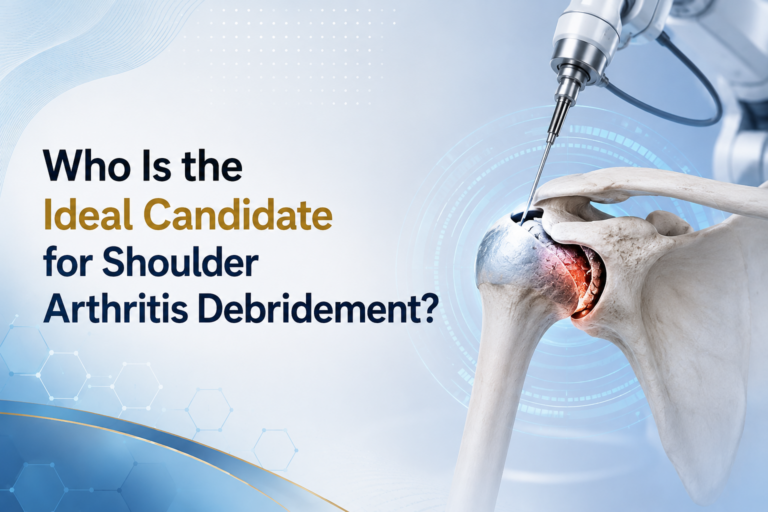
Arthroscopic shoulder debridement is a minimally invasive shoulder surgery using small incisions and a camera (arthroscope) to clean the joint and preserve remaining cartilage.
The surgeon removes:
- Loose cartilage fragments
- Inflamed joint lining (synovium)
- Bone spurs (osteophytes) that limit motion or cause pain
- Loose bodies caught in the joint
Debridement also includes suturing torn rotator cuff tendons if present and smoothing rough cartilage edges. The goal is symptom relief and preservation of the native shoulder joint—a joint-preserving procedure rather than replacement.
Debridement works best in younger, active patients with mild to moderate arthritis and reasonable cartilage remaining. Success rates for pain relief range from 60–80% in selected patients, with effects often lasting 2–5 years.
What Is Shoulder Replacement Surgery?
Shoulder replacement surgery involves removing damaged cartilage and bone and replacing them with prosthetic implants.
Total Shoulder Replacement: Replaces both the ball (humeral head) and socket (glenoid). Used for severe arthritis with intact rotator cuff.
Reverse Shoulder Replacement: Reverses the ball-and-socket anatomy, moving the load to different muscles. Used when rotator cuff is torn or when standard replacement is not possible.
Partial (Hemiarthroplasty): Replaces only the ball. Used selectively when the socket is relatively preserved.
Replacement is definitive treatment for severe arthritis and provides durable, long-term pain relief. Success rates exceed 90% for pain relief and function. Modern prostheses last 15–20+ years in most patients.
Shoulder Arthritis Debridement vs Shoulder Replacement
Debridement is appropriate when:
- Arthritis is mild to moderate
- Significant cartilage remains (imaging shows <50% loss)
- Patient is younger (under 65) and wants to preserve the joint
- Mechanical symptoms predominate (catching, locking)
- Conservative treatment has failed but symptoms are not disabling
Replacement is appropriate when:
- Arthritis is severe (bone-on-bone on imaging)
- Cartilage loss is extensive (>75%)
- Pain is disabling despite physiotherapy and injections
- Sleep is disrupted by night pain
- Patient is willing to accept activity restrictions
- Longevity and durability are primary goals
Shoulder Debridement vs Shoulder Replacement
| Factor | Arthroscopic Debridement | Shoulder Replacement |
| Best candidate | Mild–moderate arthritis, younger, active | Severe arthritis, older, low-demand activity |
| Arthritis severity | Mild to moderate; cartilage >50% remains | Severe; bone-on-bone; cartilage <25% |
| Surgical approach | Minimally invasive arthroscopy | Open surgery; implant placement |
| Incision | 3–4 small incisions (5–8 mm) | 5–7 cm anterior incision |
| Hospital stay | Day surgery or overnight | 1–2 days |
| Recovery time | 4–8 weeks to full activity | 3–6 months to full activity |
| Pain relief | 60–80% in appropriate candidates | 90%+ in most patients |
| Joint preservation | Yes; native joint retained | No; joint replaced |
| Longevity | 2–5 years; may require later replacement | 15–20+ years; revision rare <10 years |
| Return to sports | Yes; overhead activities by 6–8 weeks | Limited; no overhead contact sports |
Who Is a Good Candidate for Shoulder Arthritis Debridement?
Debridement is most successful in patients with:
- Mild to moderate arthritis visible on imaging (cartilage partially intact, no extensive bone loss)
- Age under 65, though older patients with mild arthritis may benefit
- Active lifestyle with desire to maintain overhead function
- Mechanical symptoms such as catching, locking, or loose body sensation
- Failure of conservative treatment (physiotherapy, NSAIDs, injections) for at least 3–6 months
- Preserved rotator cuff (or repairable rotator cuff tears)
- Realistic expectations understanding that relief is temporary and replacement may be needed later
Who Needs Shoulder Replacement Surgery?
Replacement becomes necessary when:
- Severe arthritis is documented on imaging (bone-on-bone, extensive cartilage loss)
- Pain is disabling despite optimal conservative treatment
- Sleep is disrupted by night pain unrelieved by medication
- Function is severely limited — unable to perform work or daily activities
- Debridement has failed or arthritis has progressed despite prior arthroscopy
- Younger age is not a contraindication if arthritis is severe and symptoms are disabling
- Patient accepts the tradeoff of joint replacement durability for activity restrictions
Can Shoulder Debridement Delay Shoulder Replacement?
Yes, in selected patients. Current orthopedic evidence shows that arthroscopic debridement can provide symptom relief lasting 2–5 years in patients with mild to moderate arthritis and well-preserved cartilage.
However, debridement cannot reverse advanced arthritis or restore lost cartilage. When cartilage is extensively damaged (>75% loss) or bone-on-bone arthritis exists, debridement provides minimal benefit and replacement should be considered upfront.
The key is appropriate patient selection: debridement works in mild-to-moderate disease; replacement is appropriate for severe disease. Some patients benefit from debridement initially, then progress to replacement when symptoms worsen. Others with severe arthritis progress directly to replacement without intermediate debridement.
Recovery After Shoulder Debridement vs Shoulder Replacement
Debridement recovery:
- Days 0–3: Minimal pain; same-day or overnight discharge
- Weeks 1–2: Return to light desk work; sling optional by week 2
- Weeks 2–4: Progressive range of motion; return to driving
- Weeks 4–8: Strengthening; return to most activities
- Full recovery: 8–12 weeks; overhead activities by 3–4 months
Replacement recovery:
- Days 0–3: Pain controlled with anesthesia and medication; 1–2 day hospital stay
- Weeks 1–6: Sling worn; gentle passive motion; physiotherapy begins
- Weeks 6–12: Active motion and strengthening; return to light work
- Months 3–6: Progressive activity; return to low-impact sports (golf, swimming) by month 5–6
- Full recovery: 4–6 months; overhead activities restricted permanently
Signs You May Need Shoulder Surgery
- Persistent shoulder pain unrelieved by rest, ice, or physiotherapy for 3+ months.
- Night pain disrupting sleep despite medication and activity modification.
- Progressive loss of shoulder motion (inability to reach overhead or behind back).
- Shoulder weakness affecting work or sports performance.
- Imaging-confirmed arthritis with mechanical symptoms (catching, locking, loose bodies).
- Failed conservative treatment (physiotherapy, NSAIDs, steroid injections) lasting 6+ months.
- Disability affecting quality of life or vocational function.
About Dr. Abhinandan Punit — Shoulder Arthroscopy & Joint Replacement Specialist, Bangalore
Dr. Abhinandan Punit is a European Board Certified Orthopaedic Surgeon with an MCh in Orthopaedics and 15+ years of comprehensive experience in shoulder arthroscopy, joint replacement, and sports medicine. He serves as Senior Consultant and Clinical Lead – Joint Replacement at Narayana Health City, Bangalore, and practices at Elite Orthocare & Multi Speciality Clinic.
Shoulder surgery expertise:
Dr. Punit performs over 1000 orthopaedic procedures annually, encompassing both arthroscopic shoulder debridement for arthritis, rotator cuff repair, labral repair, and comprehensive shoulder replacement surgery (total, reverse, and partial). His international fellowship training in shoulder arthroscopy and European Board Certification underscore his commitment to evidence-based, continuously refined surgical practice.
Consult a Shoulder Arthritis Specialist
If you are experiencing persistent shoulder arthritis pain and need clarity on whether shoulder arthritis debridement or shoulder replacement surgery is appropriate for your situation, consult Dr. Abhinandan Punit for a comprehensive evaluation and personalized treatment plan.
Frequently Asked Questions
Is shoulder debridement permanent?
No. Debridement provides temporary symptom relief, typically lasting 2–5 years. It cleans the joint and removes inflammatory tissue, but does not restore lost cartilage. Many patients eventually progress to replacement as arthritis advances or symptoms recur.
Can arthritis come back after debridement?
Yes. Arthritis is a progressive disease. Debridement removes symptoms temporarily but does not halt cartilage degeneration. Over time, remaining cartilage may wear further, requiring later replacement. Regular follow-up imaging helps monitor progression.
Which surgery has faster recovery?
Debridement has much faster recovery—4–8 weeks versus 3–6 months for replacement. However, faster recovery doesn’t equal better long-term outcomes. Replacement provides longer-lasting symptom relief and greater functional improvement, despite longer initial recovery.
Can shoulder replacement last 20 years?
Yes. Modern prostheses have excellent durability. Registry data shows 80–90% implant survival at 15 years and 70–80% at 20 years. Revision rates are low (<5% in 15 years), and most patients report satisfaction with their replacement even decades later.
Is arthroscopic shoulder surgery painful?
Minimally. Pain is controlled with regional nerve blocks and multimodal analgesia. Most patients experience minimal pain by day 2–3. Post-operative discomfort is much less than open replacement, which is why debridement recovery is faster.