
Shoulder pain requires surgery when severe rotator cuff tears, repeated dislocations, advanced arthritis, or serious fractures do not improve after 3–6 months of physiotherapy and non-surgical treatment. Most mild shoulder conditions — including inflammation, minor strains, and frozen shoulder — improve naturally with guided rehabilitation without any surgical procedure.
What Is Shoulder Pain and Why Does It Happen?
Shoulder pain develops when the muscles, tendons, ligaments, or bones of the shoulder joint are damaged, inflamed, or overloaded. The shoulder has the widest range of motion of any joint in the body — which also makes it the most vulnerable to injury and instability.
Common causes include rotator cuff tears, frozen shoulder, arthritis, tendon inflammation, shoulder dislocation, sports injuries, and repetitive overhead activities.
Can Shoulder Pain Heal Without Surgery?
Yes. The majority of shoulder pain cases improve without surgery. According to orthopaedic research, over 60% of rotator cuff injuries and shoulder impingement conditions respond well to physiotherapy and rehabilitation without requiring any surgical intervention.
Non-surgical treatment options include:
- Physiotherapy and guided rehabilitation exercises
- Rest and activity modification
- Anti-inflammatory medications
- Ice therapy for acute pain and swelling
- Posture correction and ergonomic adjustments
- Corticosteroid injections in selected cases
Mild muscle strain, tendon irritation, early frozen shoulder, and sports-related shoulder inflammation often heal completely with consistent non-surgical care.
When Does Shoulder Pain Require Surgery? (5 Clear Signs)
Doctors recommend surgery when conservative treatment fails. Here are the 5 signs that surgery may be needed:
- Rotator cuff tear is complete or large — Physiotherapy alone cannot reattach a fully torn tendon; surgical repair is needed to restore arm strength and function.
- Shoulder dislocates repeatedly — More than 2–3 dislocations damage the joint lining and surrounding tissue, requiring surgical stabilisation.
- Pain persists beyond 3–6 months of treatment — If guided physiotherapy shows no improvement after an adequate trial, surgery may be the next step.
- Arm weakness is getting worse, not better — Progressive weakness suggests ongoing tissue damage that conservative treatment cannot reverse.
- Arthritis has severely damaged the joint — Advanced joint degeneration may require shoulder replacement when daily function is significantly affected.
Surgery vs Non-Surgical Treatment — Which Is Right for You?
| Condition | Non-Surgical First? | Surgery Needed? | Recovery Time |
|---|---|---|---|
| Mild Rotator Cuff Strain | ✅ Yes | ❌ Rarely | 4–8 weeks |
| Partial Rotator Cuff Tear | ✅ Yes | ⚠️ Sometimes | 8–16 weeks |
| Complete Rotator Cuff Tear | ⚠️ Trial first | ✅ Often Yes | 4–6 months |
| First-time Dislocation | ✅ Yes | ❌ Rarely | 6–12 weeks |
| Repeated Dislocations | ⚠️ Limited | ✅ Usually Yes | 3–5 months |
| Frozen Shoulder (early) | ✅ Yes | ❌ Rarely | 3–12 months |
| Frozen Shoulder (severe) | ✅ Yes | ⚠️ If no progress | 6–12 months |
| Shoulder Arthritis (mild) | ✅ Yes | ❌ No | Ongoing |
| Shoulder Arthritis (severe) | ⚠️ Limited | ✅ Replacement | 6–12 months |
| Shoulder Fracture | ⚠️ Depends | ✅ Often Yes | 3–6 months |
How Does Each Shoulder Condition Respond to Treatment?
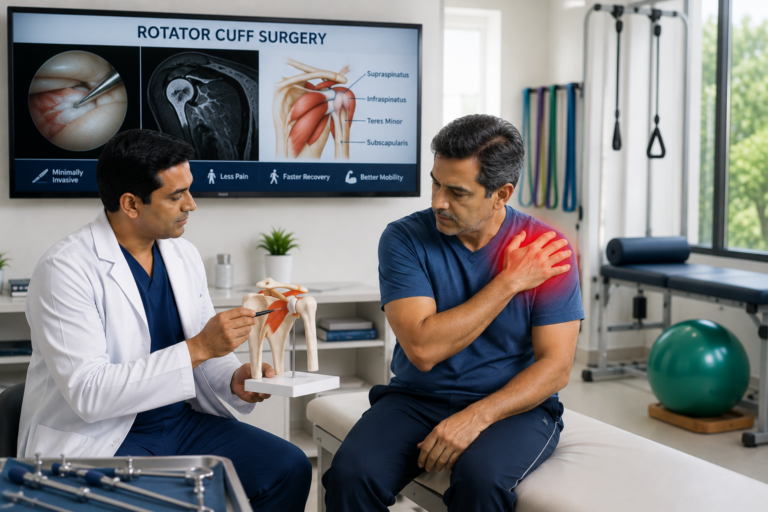
Rotator Cuff Tears – Partial tears — where the tendon is damaged but not completely severed — frequently heal with physiotherapy. Large or complete tears, especially in patients under 60 who are physically active, typically require surgical repair to restore full strength and prevent worsening damage.
Recurrent Shoulder Dislocation – A first-time dislocation is usually managed with rest, immobilisation, and physiotherapy. However, when dislocation recurs — particularly in young athletes and contact sport participants — surgery to tighten the joint capsule (Bankart repair) is often recommended to prevent long-term joint damage.
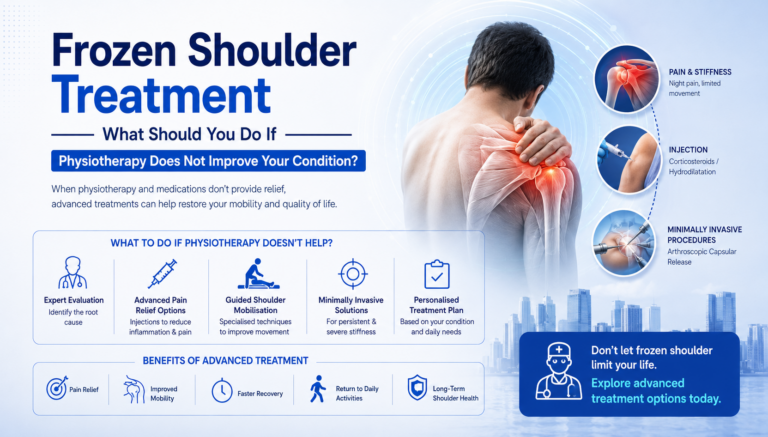
Frozen Shoulder (Adhesive Capsulitis) – Frozen shoulder almost always improves without surgery, though recovery can take 6–18 months. Physiotherapy, stretching, and injections are the primary treatment. Surgery (arthroscopic capsular release) is considered only when movement remains severely restricted after 12+ months of consistent treatment.
Shoulder Arthritis – Early to moderate arthritis responds well to physiotherapy, anti-inflammatory medications, and activity modification. Severe arthritis with significant joint destruction may require shoulder replacement surgery — a procedure with excellent outcomes and over 95% patient satisfaction rates in published studies.
Non-Surgical Treatment: What Actually Works?
1. Physiotherapy The most important non-surgical treatment for shoulder pain. A structured physiotherapy programme improves rotator cuff strength, joint stability, flexibility, and movement control. Studies show physiotherapy reduces surgical referral rates by up to 40% in shoulder impingement and partial tear cases.
2. RICE Protocol Rest, Ice, Compression, Elevation — used in the first 48–72 hours after acute shoulder injury to control swelling and pain.
3. Targeted Rehabilitation Exercises Progressive strengthening of the rotator cuff muscles and scapular stabilisers is the foundation of shoulder recovery. These exercises protect the joint and significantly reduce re-injury risk.
4. Anti-Inflammatory Medications Short-term use of prescribed anti-inflammatory medications reduces pain and swelling, making physiotherapy more comfortable and effective.
5. Corticosteroid Injections For persistent inflammation, a guided injection can provide significant pain relief and allow physiotherapy to progress. Typically effective for frozen shoulder and shoulder impingement.
What Happens If Shoulder Pain Is Left Untreated?
Ignoring shoulder pain is one of the most common mistakes patients make. Without treatment:
- A partial rotator cuff tear can progress to a complete tear
- Frozen shoulder can worsen and take 2–3 years to resolve
- Repeated dislocations cause permanent joint lining damage
- Arthritis progresses faster without supportive exercises
- Compensatory movement patterns develop, causing neck and back pain
Early treatment — even just a physiotherapy assessment — can prevent a manageable problem from becoming a surgical one.
Recovery After Shoulder Surgery: What Patients Should Expect
Recovery after shoulder surgery depends on the type of procedure, patient age, and rehabilitation consistency.
| Surgery Type | Sling Period | Physiotherapy Start | Full Recovery |
|---|---|---|---|
| Rotator Cuff Repair | 4–6 weeks | Week 6–8 | 4–6 months |
| Bankart Repair (Dislocation) | 3–4 weeks | Week 4–6 | 4–5 months |
| Arthroscopic Capsular Release | 1–2 weeks | Week 2–3 | 3–4 months |
| Shoulder Replacement | 4–6 weeks | Week 2–4 | 6–12 months |
Key factors that speed up recovery: starting physiotherapy on time, following the rehabilitation programme consistently, maintaining good nutrition, and avoiding premature return to heavy activity.
How to Prevent Shoulder Injuries
- Warm up for 10–15 minutes before any overhead or throwing activity
- Strengthen rotator cuff muscles with regular conditioning exercises
- Maintain correct posture — especially when working at a desk
- Avoid sudden increases in training load or repetitive overhead work
- Use proper lifting technique — do not lift with a locked or outstretched arm
- Stretch shoulders and chest muscles after every workout
- Seek early treatment for any shoulder pain lasting more than 2 weeks
Who is Dr. Abhinandan Punit
Dr. Abhinandan Punit is an orthopedic and sports injury specialist associated with Narayana Health, Bangalore. He focuses on ligament injuries, arthroscopic procedures, knee preservation, and sports-related orthopedic treatment.
Credentials & Experience
- 15+ years of orthopaedic experience
- European Board-Certified Orthopaedic Surgeon
- MCh Orthopaedics — international surgical training
- Associated with Elite Orthocare and Narayana Health, Bangalore
- Specialist in shoulder surgery and rotator cuff repair
- Expert in Bankart repair for shoulder instability
- Robotic joint replacement — knee and hip
- Sports injury diagnosis and rehabilitation
- Advanced minimally invasive arthroscopic procedures
- 5,000+ orthopaedic procedures performed
Conclusion
Shoulder pain does not always mean surgery. Most shoulder conditions — including rotator cuff injuries, frozen shoulder, and sports-related pain — improve significantly with physiotherapy, rest, and guided rehabilitation. Surgery becomes necessary only when damage is severe, instability is persistent, or conservative treatment has been given a fair trial without adequate improvement.
The most important step is early diagnosis. The sooner you understand what is causing your shoulder pain, the more treatment options are available — and the better your chances of a full recovery without surgery.
📞 Book Your Shoulder Assessment — Bangalore
If your shoulder:
- Hurts while lifting the arm or reaching overhead
- Causes pain during sleep that wakes you up
- Feels weak, unstable, or keeps dislocating
- Has been painful for more than 4–6 weeks without improvement
An orthopaedic evaluation can identify the cause early and prevent the condition from worsening.
✔ Shoulder pain and mobility assessment ✔ Rotator cuff and sports injury evaluation ✔ Physiotherapy and rehabilitation guidance ✔ Advanced orthopaedic treatment planning — surgical and non-surgical
📍 Elite Orthocare – Kanakapura Road, Bangalore 📍 Narayana Clinic – Electronic City.
Frequently Asked Questions
Q: Can shoulder pain heal without surgery?
Yes. Most shoulder pain cases — including rotator cuff inflammation, frozen shoulder, tendon irritation, and mild sprains — improve fully with physiotherapy, rest, and rehabilitation exercises. Surgery is generally reserved for complete tears, repeated dislocations, or severe arthritis that does not respond to 3–6 months of non-surgical treatment.
Q: When is surgery needed for shoulder pain?
Surgery is typically needed when there is a complete rotator cuff tear, recurrent shoulder dislocations (especially in young athletes), severely advanced arthritis, or a serious fracture. Surgery is also considered when physiotherapy and other non-surgical treatments fail to produce meaningful improvement after an adequate treatment period.
Q: How long does recovery take after shoulder surgery?
Recovery varies by procedure. Rotator cuff repair typically takes 4–6 months for full recovery. Bankart repair for dislocation takes 4–5 months. Shoulder replacement may take 6–12 months. Consistent physiotherapy throughout recovery is the most important factor for a successful outcome.
Q: Is physiotherapy important for shoulder pain?
Absolutely. Physiotherapy is the first-line treatment for almost all shoulder conditions. It improves rotator cuff strength, joint stability, range of motion, and reduces pain. For many patients, a well-structured physiotherapy programme eliminates the need for surgery entirely.
Q: Can sports injuries cause shoulder pain requiring surgery?
Yes. High-impact sports injuries — particularly in throwing athletes, swimmers, and contact sport participants — can cause complete rotator cuff tears, shoulder dislocations, or labral tears that may require surgical repair. However, not all sports-related shoulder injuries need surgery; many partial injuries heal well with physiotherapy.
Q: What is the difference between shoulder stiffness and frozen shoulder?
Shoulder stiffness is a general reduction in movement, often from inflammation or inactivity, and usually improves quickly with stretching and physiotherapy. Frozen shoulder (adhesive capsulitis) is a specific condition involving progressive thickening of the joint capsule, causing severe stiffness that develops in stages over months. Frozen shoulder takes significantly longer to resolve — typically 6–18 months.