
Robotic knee replacement can be worth it for patients with advanced arthritis who want enhanced surgical precision and potentially faster recovery. The value depends on your condition severity, surgeon experience with robotic systems, and the technology’s specific benefits for your case. Dr. Abhinandan Punit, an experienced robotic joint replacement surgeon in Bangalore, helps patients make informed decisions based on individual needs.
Introduction
Knee replacement surgery has evolved significantly over the past decade. Today, patients have choices—traditional surgery or robotic-assisted procedures. But is choosing robotic technology actually worth the investment? This question matters because knee replacement is a major surgical decision that affects your quality of life for years to come. The answer isn’t one-size-fits-all; it depends on your specific condition, age, activity level, and surgeon expertise.
What Is Robotic Knee Replacement?
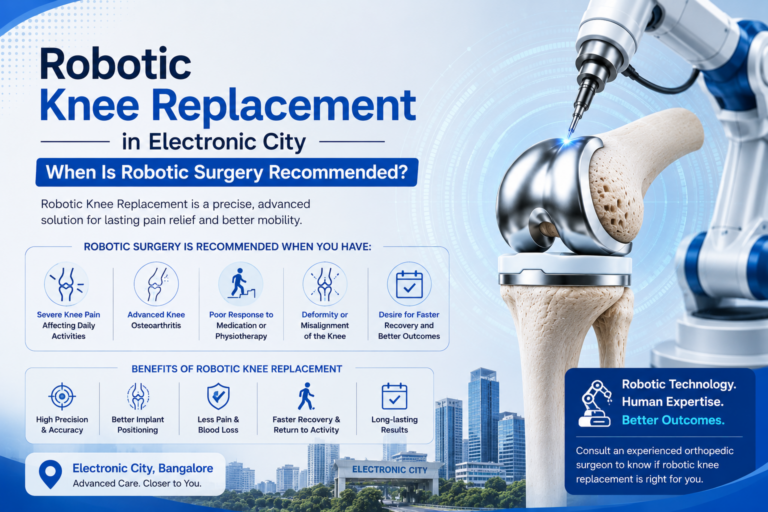
Robotic knee replacement is a minimally invasive surgical technique where a surgeon uses robotic-assisted technology to guide implant placement with sub-millimeter precision. Unlike traditional surgery, robotic systems map your knee’s unique anatomy and create a personalized surgical plan, allowing for more accurate implant positioning and alignment.
Robotic knee replacement combines human expertise with advanced technology. During the procedure, the surgeon remains in complete control while the robotic arm provides real-time feedback and precision guidance. Systems like MAKO, CORI, and Cuvis can analyze your knee’s exact geometry and help place the implant with exceptional accuracy.
The procedure begins with CT imaging that creates a 3D map of your knee joint. The surgeon uses this map to plan the exact implant position. During surgery, the robotic system guides the bone cutting and implant placement, staying within predetermined boundaries. This precision is difficult to achieve with manual techniques alone.
Is Robotic Knee Replacement Worth It?
Robotic knee replacement offers measurable advantages in surgical precision and implant alignment, which can translate to better long-term outcomes and patient satisfaction. However, “worth it” depends on your individual factors—severity of arthritis, activity level, surgeon experience, and whether you’re a candidate for the procedure.
The value proposition centers on three main factors:
Precision Benefits:
- Sub-millimeter accuracy in implant positioning
- Personalized alignment based on your unique anatomy
- Reduced outliers in component placement (studies show fewer poorly aligned implants)
Recovery Potential:
- Faster return to function in some patients
- Potentially reduced pain during early recovery phases
- Better proprioception (body’s sense of knee position) reported by many patients
Long-term Durability:
- Improved implant survival rates due to better alignment
- Reduced revision surgery risk in long-term follow-up studies
- Better mechanical advantage for active patients
However, robotic surgery isn’t better for everyone. Success depends on having an experienced surgeon who uses the technology effectively, not just having the technology itself.
Who Benefits Most from Robotic Knee Replacement?
Patients with severe knee arthritis, high activity levels, demanding occupations, or specific anatomical challenges benefit most from robotic knee replacement. Ideal candidates want optimal long-term outcomes and are willing to invest in advanced surgical technology for enhanced precision.
Best Candidates Include:
- Active patients wanting to return to sports or demanding physical activities
- Patients with complex anatomy (previous surgery, unusual bone alignment)
- Younger patients (40s-60s) planning 30+ years with the implant
- Those with high functional demands in their work or lifestyle
- Patients seeking maximum implant longevity to avoid future revision surgery
- Individuals with obesity or metabolic conditions requiring precise alignment
Poor candidates include patients with severe bone loss, advanced comorbidities, or those unable to comply with post-operative rehabilitation.
How Is Robotic Knee Replacement Different from Traditional Surgery?
Robotic knee replacement differs primarily in surgical planning, precision, and implant positioning. Traditional surgery relies on the surgeon’s manual judgment and visual assessment, while robotic surgery uses pre-operative imaging and real-time guidance to achieve more consistent, personalized alignment.
Key Differences:
| Feature | Robotic Knee Replacement | Traditional Knee Replacement |
|---|---|---|
| Surgical Planning | CT-based 3D mapping and personalized plan | Manual assessment and standard approach |
| Implant Alignment | Sub-millimeter precision (±2mm accuracy) | ±5mm variability common |
| Bone Preparation | Computer-guided with exact dimensions | Manual instruments, surgeon-dependent |
| Implant Positioning | Personalized to patient’s anatomy | Standard positioning algorithm |
| Surgical Time | Typically 60-90 minutes | Typically 60-90 minutes |
| Recovery Timeline | Often faster functional recovery | Standard recovery curve |
| Learning Curve | Requires surgeon training and experience | Familiar technique for experienced surgeons |
| Cost | Generally 15-25% higher | Standard cost baseline |
The fundamental difference: precision through technology guidance versus surgeon experience alone.
What Are the Advantages and Limitations of Robotic Knee Replacement?
Advantages of robotic knee replacement include superior surgical precision, personalized implant positioning, reduced revision rates, and faster recovery for many patients. Limitations include higher cost, increased operative time for complex cases, requirement for surgeon expertise, and that results still depend on post-operative rehabilitation.
Advantages:
- Superior implant alignment – Sub-millimeter precision vs. manual variability
- Fewer revision surgeries – Better positioning reduces early failures
- Faster return to function – Many patients resume activities sooner
- Personalized to your anatomy – Not a one-size-fits-all approach
- Reduced outliers – Consistent results even with challenging anatomies
- Better satisfaction rates – Patients report improved long-term outcomes
Limitations:
- Higher upfront cost (typically Rs. 2-3 lakhs more than traditional surgery)
- Requires surgeon training and experience with robotic systems
- Pre-operative imaging adds time and cost
- Not all insurance covers robotic procedures equally
- Results depend heavily on surgeon expertise
- Rehabilitation still requires active patient compliance
- Not ideal for patients with severe bone loss
What Factors Should You Consider Before Choosing Robotic Knee Replacement?
- Assess your activity level – Are you active or sedentary? Robotic surgery benefits active patients more.
- Evaluate your anatomy – Ask if your knee has complex anatomy, previous surgery, or alignment issues that benefit from robotic precision.
- Discuss surgeon experience – Ensure your surgeon has extensive robotic knee replacement experience (ideally 500+ procedures).
- Understand cost implications – Compare total costs including implants, technology fees, and insurance coverage.
- Plan your recovery timeline – Consider your job demands and lifestyle during the 3-6 month recovery period.
What Advice Does Dr. Abhinandan Punit Give to Patients?
Dr. Abhinandan Punit advises patients that robotic knee replacement offers real benefits for appropriate candidates but isn’t necessary for everyone. The decision should be based on your condition severity, long-term goals, and a thorough discussion of expected outcomes.
Dr. Abhinandan Punit, an European Board Certified Orthopedic Surgeon with 15+ years of clinical experience, emphasizes that technology enhances but doesn’t replace surgical skill. He is certified in MAKO, CORI, and Cuvis robotic systems and performs 700+ joint replacement surgeries annually, giving him unique perspective on when robotic surgery truly adds value.
His approach:
- Honest assessment – Not every patient needs robotic surgery
- Evidence-based decisions – Using clinical data, not marketing claims
- Personalized recommendations – Tailoring technology to individual patient needs
- Transparent communication – Explaining costs, benefits, and realistic expectations
- Emphasis on rehabilitation – Robotic surgery is the first step; your effort during recovery determines outcomes
Patients at Elite Orthocare and Narayana Health City benefit from his expertise in helping them understand whether robotic technology fits their specific situation.
When Should You Consult an Orthopedic Surgeon?
Consult an orthopedic surgeon when knee pain limits your daily activities, causes persistent swelling, affects your walking pattern, or doesn’t improve with conservative treatment after 6-8 weeks. An evaluation helps determine if you’re a candidate for robotic knee replacement.
Schedule a consultation if you experience:
- Chronic knee pain affecting work, hobbies, or daily activities
- Swelling that doesn’t respond to rest, ice, or medication
- Knee giving way or feeling unstable
- Difficulty climbing stairs or walking long distances
- Stiffness that limits your range of motion
- Imaging showing advanced arthritis
An orthopedic surgeon can imaging assess if robotic knee replacement is appropriate for your situation and help you make an informed decision.
Book a Consultation
If you’re experiencing chronic knee pain or advanced arthritis affecting your quality of life, consult with Dr. Abhinandan Punit to explore whether robotic knee replacement is appropriate for you. At Elite Orthocare (Kanakapura Road) and Narayana Health City, Bangalore, he provides personalized evaluations to help you make informed decisions about your knee replacement surgery.
FAQ Section
1. Is robotic knee replacement worth the extra cost?
Yes, for appropriate candidates. The additional cost (typically Rs. 2-3 lakhs) is justified by superior precision, reduced revision risk, and better long-term outcomes. If you’re active and plan 30+ years with the implant, robotic surgery often provides better value over time. However, for low-demand patients, traditional surgery may be sufficient.
2. Does robotic knee replacement last longer?
Studies suggest robotic knee replacement may have longer implant survival due to superior alignment. Better positioning reduces abnormal wear patterns and mechanical stress. While standard implants last 15-20 years, robotic-assisted implants show trends toward extended durability, though long-term data (30+ years) is still developing.
3. Is robotic knee replacement safer?
Robotic knee replacement isn’t inherently safer regarding infection or blood clots—major risks are similar to traditional surgery. However, robotic technology reduces technical complications like malalignment, component loosening, and early failure, making it safer from an implant perspective for appropriate candidates.
4. Who is a good candidate for robotic knee replacement?
Good candidates are active patients with advanced knee arthritis, those with complex anatomy, younger patients (40s-60s), and individuals with high functional demands. Older patients with low activity levels and simple knee anatomy may not benefit as much. Your surgeon should evaluate your specific anatomy and lifestyle.
5. Is recovery faster after robotic knee replacement?
For many patients, yes. Because robotic surgery achieves precise alignment and minimal bone removal, some patients experience faster functional recovery and return to activities. However, recovery depends on individual factors, rehabilitation compliance, and pre-operative fitness level—robotic surgery doesn’t eliminate the need for diligent post-operative physical therapy.
6. When should I consult Dr. Abhinandan Punit for knee replacement?
Consult when knee pain limits your daily activities and conservative treatment hasn’t worked after 6-8 weeks. Dr. Abhinandan Punit’s expertise in robotic systems (MAKO, CORI, Cuvis) at Elite Orthocare and Narayana Health City helps determine if robotic surgery fits your needs. He performs 700+ joint replacements annually in Bangalore and provides honest guidance about whether robotic technology benefits your specific case.