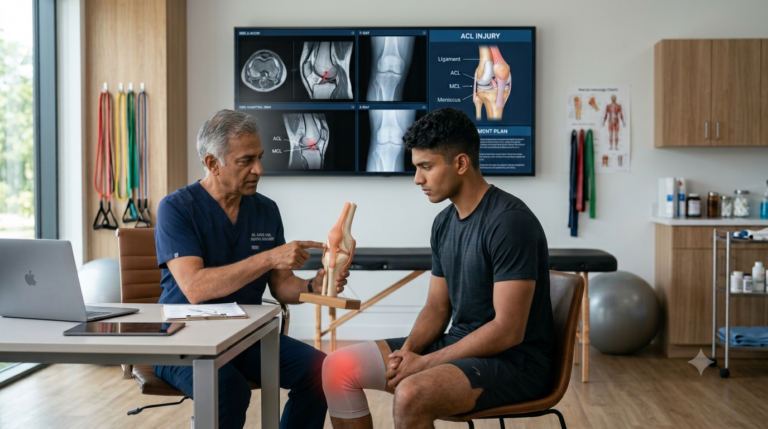

Quality sports medicine specialists in Bangalore are fellowship-trained orthopedic surgeons who diagnose and treat chronic sports injuries using imaging, biomechanical assessment, and evidence-based rehabilitation. Look for specialists with arthroscopic surgery expertise, sports physiotherapy access, and personalized return-to-play planning. They should evaluate imaging findings alongside functional testing and offer conservative or surgical treatment based on injury severity and athlete goals.
Quick Summary
- Sports medicine specialists diagnose and manage both acute and chronic sports injuries.
- Chronic sports injuries lasting 6+ weeks require specialist evaluation to prevent permanent damage.
- Specialist care includes imaging, functional testing, and personalized sports rehabilitation protocols.
- Arthroscopic surgery is minimally invasive treatment for tears, instability, and impingement.
- Early specialist consultation reduces surgery rates, accelerates return to sport, and prevents arthritis.
Introduction
Athletes experiencing persistent pain, weakness, or instability deserve specialized care. Finding the right sports injury doctor Bangalore means understanding which specialists have the training, experience, and infrastructure to manage chronic sports injuries effectively. This guide explains what sports medicine specialists do, how to identify qualified practitioners, and why early specialist consultation matters.
 What Are Chronic Sports Injuries?
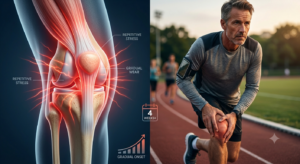
Chronic sports injuries develop gradually from repetitive stress or persist for more than 4–6 weeks after initial injury. Unlike acute injuries (sudden onset with clear trauma), chronic injuries often go unnoticed until pain and dysfunction become significant.
The difference matters: acute injuries may resolve with rest and physiotherapy, while chronic injuries typically require specialist evaluation and targeted treatment. Many athletes ignore early warning signs—mild pain, intermittent swelling, slight weakness—hoping symptoms resolve. This delay allows structural damage to worsen, increasing the likelihood of surgery and complications like post-traumatic arthritis.
Early diagnosis and treatment prevent progression and improve outcomes substantially.
Which Chronic Sports Injuries Are Most Common?
ACL injuries — Anterior cruciate ligament tears in the knee from sudden direction changes or deceleration; common in football, basketball, skiing.
Meniscus injuries — Cartilage tears causing pain, swelling, locking; often coexist with ACL injuries.
Rotator cuff tears — Tendon damage in the shoulder from overhead activities or falls; common in swimming, throwing sports, gymnastics.
Shoulder instability — Joint looseness from repetitive dislocation or subluxation; affects overhead athletes.
Tennis elbow and golfer’s elbow — Tendon inflammation at the elbow from repetitive gripping or throwing; affect racquet sport players and throwers.
Achilles tendinopathy — Tendon inflammation or degeneration affecting runners and jumping athletes.
Patellar tendinopathy — Tendon pain below the kneecap affecting jumping athletes and runners.
Each requires specialist assessment to distinguish simple inflammation from structural tears requiring surgery.
When Should You See a Sports Medicine Specialist?
Consult a sports medicine doctor Bangalore when:
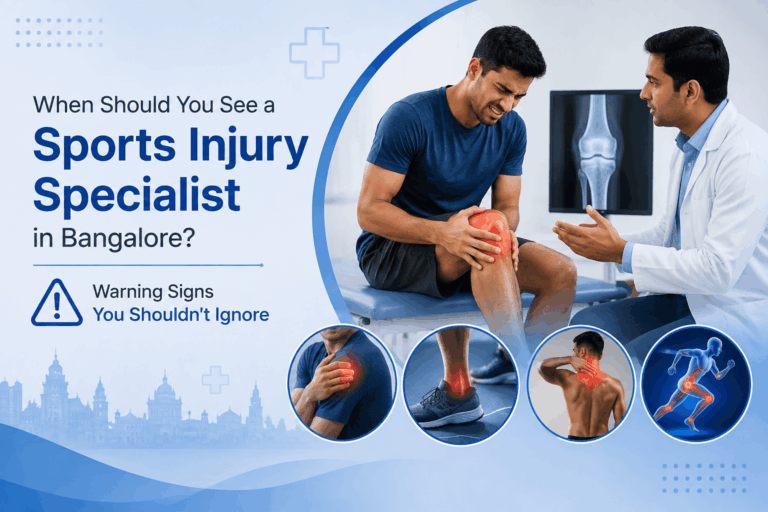
- Pain persists beyond 4–6 weeks despite rest, ice, and physiotherapy
- Swelling is recurrent — returns after activity or subsides inconsistently
- Joint instability — sensation of the joint “giving way” or feeling loose
- Reduced athletic performance that doesn’t improve with training modifications
- Repeated similar injuries — recurrent ankle sprains, hamstring strains, shoulder subluxation
- Persistent stiffness limiting range of motion months after injury
- Night pain disrupting sleep despite conservative treatment
- MRI findings confirming structural damage (tears, cartilage loss)
Early specialist evaluation prevents unnecessary imaging and accelerates evidence-based treatment.
What Does a Sports Medicine Specialist Do?
Sports medicine specialists perform comprehensive athlete evaluation:
Clinical examination — Functional movement assessment, ligament testing, muscle strength evaluation, pain reproduction tests specific to the injured structure.
Sports-specific assessment — Understanding the athlete’s sport, position, training volume, and return-to-play goals shapes treatment recommendations.
Advanced imaging — MRI, ultrasound, and sometimes CT imaging to identify structural damage (tears, cartilage loss, inflammation) that clinical examination alone cannot detect.
Biomechanical analysis — Assessment of movement patterns, muscle imbalances, and technique flaws that contribute to injury and risk of recurrence.
Functional testing — Hop tests, cutting drills, and sport-specific movements to objectively measure readiness for return to play.
Personalized treatment planning — Recommendation of physiotherapy, activity modification, injections, or surgery based on imaging findings and functional goals.
Return-to-play protocols — Structured, phased progression from injury to full sport participation, minimizing re-injury risk.
What Treatments Do Sports Medicine Specialists Offer?
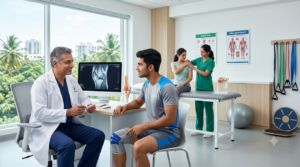
Conservative treatments form the foundation:
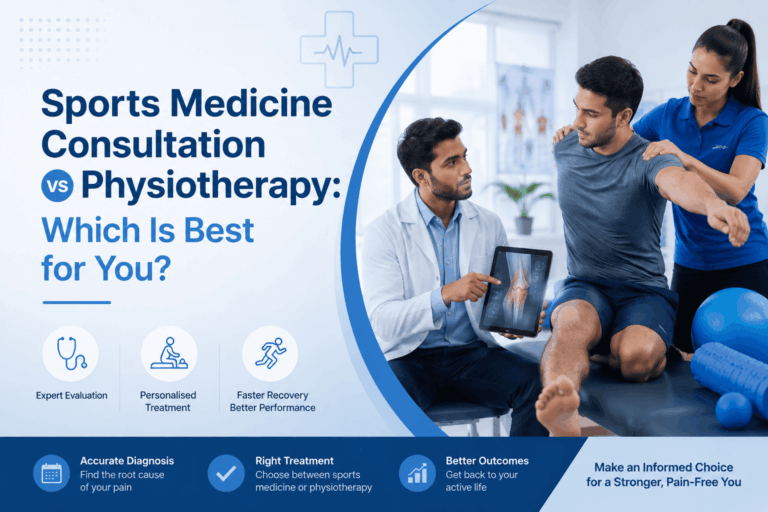
Sports physiotherapy — Structured rehabilitation addressing strength deficits, movement patterns, proprioception, and sport-specific training. Most athletes improve with high-quality physiotherapy lasting 3–6 months.
Activity modification — Adjusting training volume, intensity, and technique to allow healing while maintaining fitness.
Injections — Steroid or PRP (platelet-rich plasma) injections may reduce inflammation and facilitate rehabilitation in selected cases.
Surgical treatments are reserved for injuries not responding to conservative care:
Arthroscopic surgery — Minimally invasive repair of ACL injuries, meniscus tears, rotator cuff damage, and cartilage lesions using small incisions and direct visualization.
ACL Reconstruction — Surgical restoration of the anterior cruciate ligament using autograft or allograft.
Meniscus repair — Arthroscopic suturing of repairable meniscus tears; removal only when repair is impossible.
Shoulder stabilization — Arthroscopic repair of labral tears causing instability.
Treatment selection is individualized based on injury type, severity, athlete age and demands, and imaging findings.
How Do You Choose the Right Sports Medicine Specialist in Bangalore?
Evaluate these factors:
Fellowship training — Sports medicine fellowship (1–2 years) indicates specialized training in injury diagnosis, management, and surgery. Verify through medical credentials databases.
Arthroscopy expertise — Specialists experienced with arthroscopic ACL reconstruction, meniscus repair, and rotator cuff repair demonstrate advanced surgical capability.
Multidisciplinary approach — Access to dedicated sports physiotherapy, strength and conditioning coaching, and imaging services within the facility.
Athlete-centered communication — Specialists should understand return-to-play goals and discuss realistic timelines, not just “healing” the injury.
Hospital infrastructure — Advanced imaging (MRI, ultrasound), surgical facilities, and rehabilitation space indicate institutional commitment to comprehensive sports medicine care.
Published outcomes or case volumes — Specialists should be able to discuss their experience with specific injuries.
Why Is Early Sports Medicine Treatment Important?
Preventing cartilage damage: Untreated instability or repetitive impact accelerates cartilage wear. Early stabilization protects articular cartilage and prevents post-traumatic arthritis years later.
Avoiding complications: Delayed treatment of ACL tears increases the risk of secondary meniscus damage. Early repair of meniscus tears preserves meniscal tissue and reduces future degenerative joint disease.
Faster return to sport: Athletes with structured, evidence-based rehabilitation return to play 2–4 weeks sooner than those without specialist guidance.
Better long-term outcomes: Early intervention identifies modifiable injury risk factors (biomechanical flaws, training errors, muscle imbalances) and corrects them, reducing recurrence rates.
Reduced surgery necessity: Many acute and chronic sports injuries improve substantially with high-quality physiotherapy. Late presentation with structural damage often necessitates surgery; early treatment may avoid this.
Sports Medicine Specialist vs General Orthopedic Doctor
| Aspect | Sports Medicine Specialist | General Orthopedic Doctor |
| Training | 5–6 years orthopedic residency + 1–2 year sports fellowship | 5–6 years orthopedic residency only |
| Athlete care focus | Specialized; performance and return-to-play emphasis | General; may see few athletes |
| Injury assessment | Functional, sport-specific testing integrated | Clinical examination focus |
| Rehabilitation oversight | Active involvement; coordinates physiotherapy | Limited involvement; referral only |
| Arthroscopy skill | High volume; advanced techniques | Variable; less frequent |
| Return-to-play planning | Structured, phased protocols | General clearance; limited specificity |
| Injury prevention | Emphasis on biomechanics and training modification | Limited prevention focus |
| Performance optimization | Yes; addresses deficits limiting performance | No; focuses on injury/disease treatment |
Signs Your Sports Injury Needs Specialist Evaluation
- Pain or swelling persisting 6+ weeks despite rest and physiotherapy.
- Sense of instability; joint feeling “loose” or “giving way.”
- Reduced range of motion affecting sport participation despite stretching.
- Muscle weakness or atrophy visible compared to the uninjured side.
- Positive MRI findings (tears, cartilage damage, ligament injury) requiring treatment guidance.
- Recurrent similar injuries; pattern of re-injury despite recovery attempts.
- Night pain disrupting sleep; persistent pain at rest.
7 Questions to Ask Before Choosing a Sports Medicine Specialist
- Are you fellowship-trained in sports medicine? (Yes/no; name the fellowship and year completed)
- How many ACL reconstructions, meniscus repairs, or rotator cuff repairs do you perform annually? (Target: 50+ per procedure; indicates experience)
- Do you work with an in-house sports physiotherapy team, or do you refer externally? (In-house coordination produces better outcomes)
- What is your approach to return-to-play decision-making? (Should be structured, phased, objective; not time-based alone)
- Can you discuss your outcomes data for athletes returning to their sport? (Specialists should track return-to-sport rates and satisfaction)
- Do you use ultrasound-guided injections if indicated? (Ultrasound guidance improves accuracy and outcomes)
- How do you address modifiable injury risk factors (biomechanics, strength imbalances)? (Should discuss prevention, not just treatment)
Frequently Asked Questions
Can chronic sports injuries heal without surgery?
Most do. Studies show that 60–80% of sports injuries improve significantly with high-quality physiotherapy, activity modification, and sport-specific rehabilitation. Surgery is reserved for structural injuries (ACL tears, meniscus tears) that don’t improve with conservative care or significantly limit function.
How long should sports pain last?
Acute pain from minor injuries typically resolves in 2–4 weeks. Pain persisting beyond 4–6 weeks warrants specialist evaluation. Chronic pain lasting months requires imaging and functional assessment to identify structural damage or movement dysfunction perpetuating symptoms.
When is MRI necessary?
MRI is indicated when clinical examination suggests significant injury (ligament tear, meniscus tear, rotator cuff tear) or when symptoms persist despite 2–4 weeks of conservative care. Not every sports injury requires imaging; specialist examination guides imaging appropriateness.
Is physiotherapy enough?
For most injuries, yes. High-quality physiotherapy addressing strength, flexibility, proprioception, and sport-specific movement patterns resolves 60–80% of sports injuries. Some structural injuries (complete ACL tears, displaced meniscus tears) require surgery despite physiotherapy.
What injuries require arthroscopy?
Complete ligament tears, meniscus tears with mechanical symptoms (locking, catching), rotator cuff tears, and recurrent shoulder instability often require arthroscopic repair. Your specialist will determine if arthroscopy would benefit your specific injury.
Can I continue playing with knee pain?
Not safely without specialist guidance. Continued play on an injured knee risks secondary damage (meniscus tears following ACL injury, cartilage damage from instability). Specialist evaluation and activity modification are essential before resuming sport.
When should I see a sports medicine doctor?
Immediately if injury prevents weight-bearing or causes severe pain. Within 2 weeks if pain and swelling persist. Within 4–6 weeks if pain is mild but non-resolving with rest and self-care. Early specialist consultation prevents complications and accelerates return to sport.
How long does rehabilitation take?
Minor injuries: 4–8 weeks. Moderate injuries: 8–12 weeks. Major injuries (ACL reconstruction, rotator cuff repair): 4–6 months. Return-to-sport timelines vary by injury type, surgical intervention, athlete age, and adherence to rehabilitation. Your specialist will provide personalized timelines.
About Dr. Abhinandan Punit — Sports Medicine & Orthopedic Surgery Specialist, Bangalore
Dr. Abhinandan Punit is a European Board Certified Orthopaedic Surgeon with an MCh in Orthopaedics and 15+ years of comprehensive experience in adult joint replacement, sports medicine, shoulder arthroscopy, and sports injury management. He serves as Senior Consultant and Clinical Lead – Joint Replacement at Narayana Health, Bangalore, and practices at Elite Orthocare Clinic.
Sports medicine expertise:
Dr. Punit performs over 1000 orthopedic procedures annually, encompassing ACL reconstruction, meniscus repair, rotator cuff repair, shoulder instability surgery, arthroscopic procedures for sports injuries, and comprehensive rehabilitation oversight. His international fellowship training and European Board Certification reflect his commitment to evidence-based sports medicine practice.
Clinical approach:
Dr. Punit emphasizes conservative management with structured sports physiotherapy and functional rehabilitation, reserving surgery for injuries that fail conservative care or require structural repair. His athlete-centered approach prioritizes return-to-play timelines and injury prevention through biomechanical assessment and training optimization.
Service area:
Dr. Punit serves athletes and active patients throughout Bangalore (South Bangalore, Electronic City, Kanakapura Road, JP Nagar, Bannerghatta Road) and receives patients from across India for specialized sports injury consultation and management.
Consult a Sports Medicine Specialist Today
If you are experiencing persistent knee, shoulder, elbow, or ankle pain related to sports or athletic activity, consult Dr. Abhinandan Punit for a comprehensive sports medicine evaluation and a personalized, evidence-based treatment plan designed to get you back to sport safely and effectively.