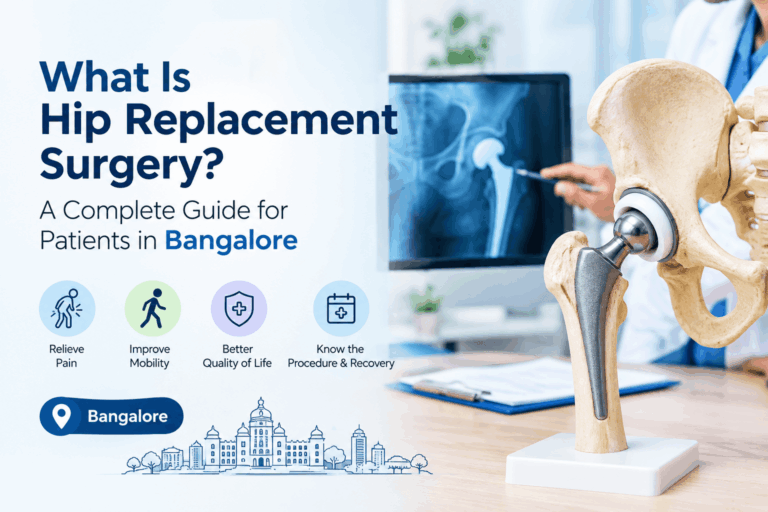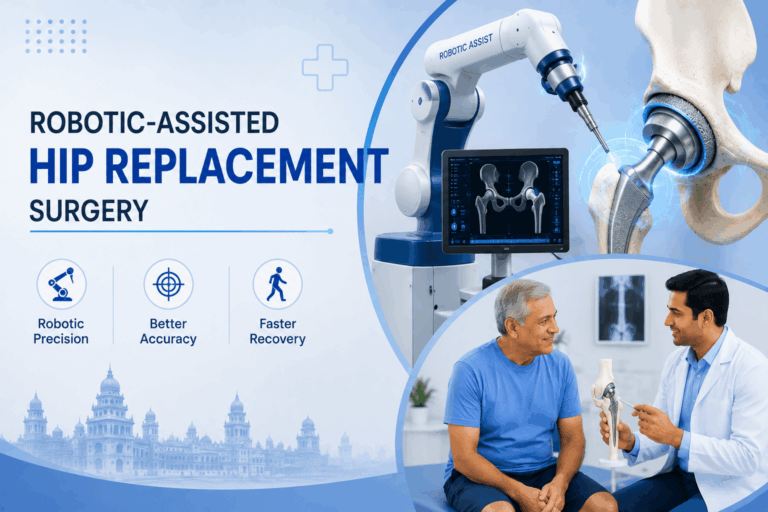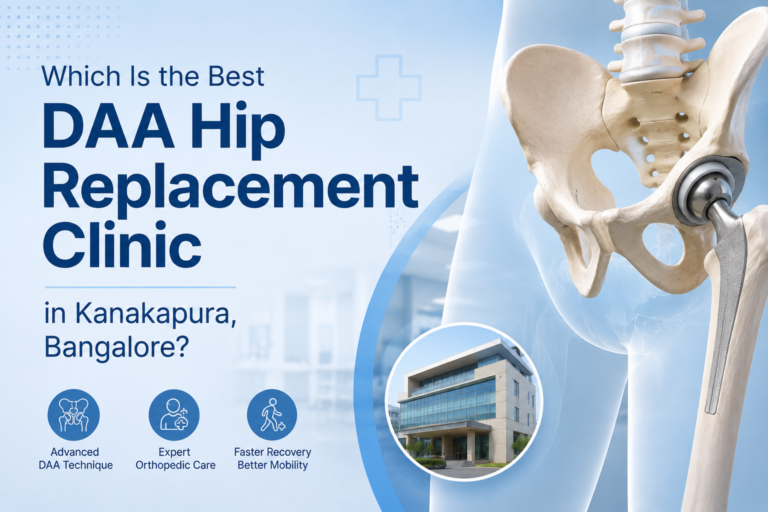

A partial hip replacement replaces only the damaged ball (femoral head) of the hip joint, while a total hip replacement replaces both the ball and the socket. The right procedure depends on the cause of hip damage, joint condition, age, activity level, and your orthopaedic surgeon’s recommendation.
What Is Partial Hip Replacement?
A partial hip replacement, also called hemiarthroplasty, replaces only the damaged femoral head (the ball of the hip joint). The natural hip socket remains unchanged.
Doctors commonly recommend partial hip replacement for:
- Certain hip fractures
- Older patients with femoral neck fractures
- Patients whose hip socket is healthy
- Individuals with limited damage to the hip joint
Because only one part of the joint is replaced, the surgery is generally less extensive than a total hip replacement.
What Is Total Hip Replacement?
Total hip replacement involves replacing both the damaged femoral head and the hip socket with artificial implants.
This procedure is commonly recommended for:
- Severe hip arthritis
- Osteoarthritis
- Rheumatoid arthritis
- Advanced hip degeneration
- Chronic hip pain affecting daily life
Total hip replacement aims to relieve pain, restore mobility, and improve long-term joint function.
Partial Hip Replacement vs Total Hip Replacement
| Feature | Partial Hip Replacement | Total Hip Replacement |
| Joint Replaced | Ball only | Ball and socket |
| Common Reason | Hip fracture | Arthritis and joint damage |
| Surgery Duration | Usually shorter | Slightly longer |
| Recovery | Often quicker initially | Depends on rehabilitation |
| Implant | One component | Two components |
| Long-term Use | Selected patients | Most arthritis patients |
Both procedures can provide excellent outcomes when performed for the right indication.
Who Needs a Partial Hip Replacement?
A partial hip replacement may be recommended if you have:
- A displaced femoral neck fracture
- Healthy hip cartilage
- Limited joint damage
- Good hip socket condition
Your surgeon evaluates X-rays, MRI scans (if needed), and your overall health before recommending surgery.
Who Needs Total Hip Replacement?
Total hip replacement is usually recommended for patients with:
- Advanced osteoarthritis
- Chronic hip pain
- Severe cartilage loss
- Reduced mobility
- Hip stiffness affecting daily activities
If both the ball and socket are damaged, total hip replacement generally provides better long-term outcomes.
What Are the Benefits of Partial Hip Replacement?
A partial hip replacement offers several advantages for selected patients.
Benefits may include:
- Relief from hip pain
- Restoration of mobility
- Shorter surgical time
- Smaller amount of bone removal
- Faster early recovery in appropriate patients
The success of the procedure depends on choosing the right patients.
What Is Recovery Like?
Recovery varies depending on age, overall health, and rehabilitation.
Most patients begin:
- Standing within one day
- Walking with assistance shortly after surgery
- Physiotherapy during the hospital stay
- Strengthening exercises during recovery
Many patients gradually return to daily activities over the following weeks or months.
Are There Any Risks?
Like all surgeries, hip replacement carries certain risks.
These may include:
- Infection
- Blood clots
- Hip dislocation
- Implant loosening
- Leg length difference
- Fracture around the implant
Following your surgeon’s advice and physiotherapy program helps reduce these risks.
How Does Your Surgeon Decide?
Choosing between partial hip replacement and total hip replacement depends on several factors.
Your orthopaedic surgeon considers:
- Age
- Cause of hip damage
- Bone quality
- Activity level
- Overall health
- Imaging findings
- Lifestyle goals
An individualized treatment plan provides the best chance of long-term success.
Frequently Asked Questions
What is a partial hip replacement?
A partial hip replacement replaces only the damaged femoral head while preserving the natural hip socket. It is commonly performed for certain hip fractures when the socket remains healthy.
Is partial hip replacement better than total hip replacement?
Neither procedure is universally better. A partial hip replacement is suitable for selected fractures, whereas total hip replacement is usually recommended for arthritis affecting the entire hip joint.
How long does recovery take after a partial hip replacement?
Many patients begin walking within a day or two after surgery. Recovery continues over several weeks to months depending on age, physiotherapy, and overall health.
Can a partial hip replacement be converted to a total hip replacement?
Yes. In some cases, a partial hip replacement may later be converted to a total hip replacement if arthritis develops or symptoms persist.
How does a surgeon decide between partial and total hip replacement?
The decision is based on the cause of hip damage, condition of the hip socket, patient’s age, activity level, imaging findings, and overall health.
About Dr. Abhinandan Punit
Dr. Abhinandan Punit is a European Board-Certified Orthopaedic Surgeon in Bangalore with 15+ years of experience and 6,000+ orthopaedic surgeries performed. He specializes in robotic hip replacement, Direct Anterior Approach (DAA) hip replacement, sports injury management, and advanced joint reconstruction using evidence-based surgical techniques.
Consult for Hip Replacement in Bangalore
If you have persistent hip pain, difficulty walking, or have been advised to undergo hip replacement surgery, an expert evaluation can help determine the most appropriate treatment.
Dr. Abhinandan Punit provides comprehensive hip assessment, advanced hip replacement surgery, and personalized rehabilitation plans focused on restoring mobility and improving long-term joint health.
Book an appointment to discuss your treatment options and receive an individualized hip care plan.
Elite Orthocare, Kanakapura Road, Bangalore Narayana Clinic, Electronic City, Bangalore