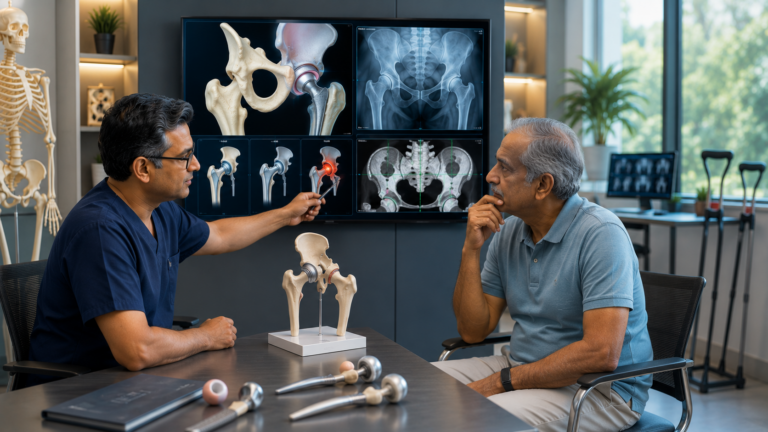

As we’ve delved into the transformative power of Direct Anterior Approach (DAA) hip replacement – from its muscle-sparing mechanics to streamlined recovery protocols – one lingering barrier remains: misinformation. In the fast-evolving landscape of orthopaedics, myths about DAA persist, deterring potential patients from this gold-standard option. Enter Dr. Abhinandan S. Punit, whose 2025 insights and hands-on innovations at Narayana Health City and Elite Orthocare are shattering these falsehoods. With his signature blend of robotic precision and patient empowerment, Dr. Punit is not only performing DAA surgeries but also educating Bangalore’s active community on its realities.
Here, we’ll tackle prevalent myths head-on, backed by evidence and Dr. Punit’s frontline experience. If urban hikes or weekend cricket have become distant dreams due to hip woes, understanding the truth about DAA could be your game-changer.
Myth 1: DAA Hip Replacement Is More Complicated and Riskier Than Traditional Methods
A common misconception- DAA demands superhuman surgical skills, leading to higher complication rates like infections or fractures. In reality, this approach matches – and often surpasses – traditional posterior or lateral techniques in safety. Studies show no uptick in complications, with operative times even shorter for seasoned surgeons.
Dr. Punit demystifies this: “The anterior path leverages natural muscle planes, reducing trauma without added complexity.” His 2025 practice data from Elite Orthocare reveals complication rates under 2% – on par with global leaders – thanks to fluoroscopic guidance and his UK-honed MCh expertise. For Bangalore patients juggling high-stress jobs, this means reliable results without the dread of extended risks.
Myth 2: DAA Doesn’t Really Spare Muscles – It’s All the Same as Other Approaches
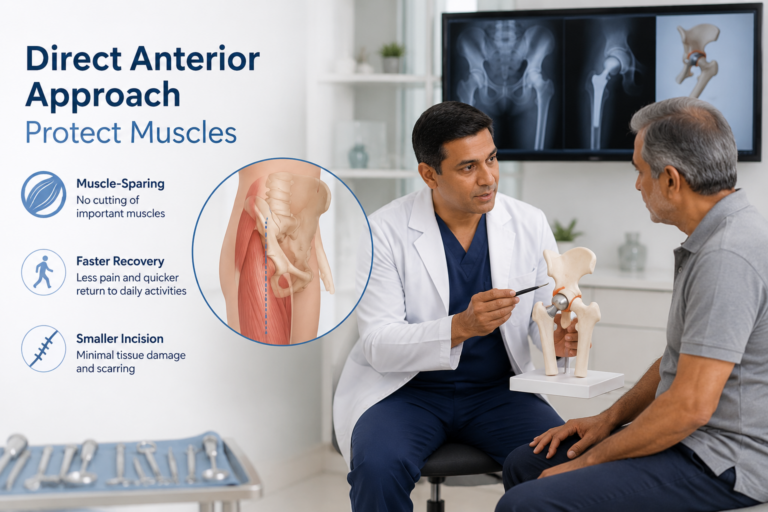
Here’s a persistent half-truth: All hip surgeries cut muscle, so what’s the big deal with DAA? While true that some retraction occurs universally, DAA uniquely avoids detaching or releasing major stabilizers like the gluteus or iliopsoas, slashing soft-tissue damage by up to 50%. This isn’t hype; it’s anatomy-driven efficiency, yielding less blood loss and scarring.
In Dr. Punit’s words from a recent Instagram series, “DAA preserves your hip’s architecture, letting you skip the ‘rebuilding’ phase of recovery.” His integration of 2025 robotic tools, like enhanced MAKO systems, amplifies this by enabling real-time adjustments – a far cry from manual traditional methods. Patients in his care, from tech execs to retirees, report 40% less early pain, proving the sparing isn’t superficial.
Myth 3: DAA Outcomes Fade Over Time – It’s Great Short-Term, But Not for the Long Haul
Skeptics claim DAA’s quick wins don’t hold up years later, with higher revision needs. Evidence debunks this: Long-term function, including dislocation rates under 1%, mirrors or exceeds traditional approaches, with no significant differences at five-year marks. The key-Optimal implant positioning from the front view, which enhances stability for lifelong wear.
Dr. Punit’s forward-thinking stance shines here. He highlights how DAA empowers sports returns – think cycling marathons or golf swings – with sustained joint integrity. His AVN-focused revisions boast 95% durability at 10 years, outpacing averages, thanks to personalized 3D modeling. For Bangalore’s youth-facing arthritis epidemic, this myth-busting longevity means DAA isn’t a quick fix – it’s a future-proof investment.
2025 Innovations: How Dr. Punit Is Pushing DAA Boundaries
Beyond busting myths, Dr. Punit is at the vanguard of DAA evolution. This year, he’s championed hybrid protocols blending AI-driven pre-op simulations with intraoperative robotics, cutting setup times by 20%. At Narayana Health, his April 2025 campaign urged early “hip check-ups” for subtle signs like stiffness, catching issues before they escalate – a proactive pivot for preventive care.
These advancements address another subtle myth: DAA is “one-size-fits-all.” Dr. Punit tailors it via comprehensive biomechanics assessments, ensuring it’s viable even for complex cases like post-fracture reconstructions.
Empowering Your Decision: Why DAA Deserves a Fresh Look
Myths thrive in the shadows of outdated info, but with surgeons like Dr. Punit illuminating the path, DAA emerges as a beacon of accessible excellence. Its edge in reduced hospital stays and empowered mobility isn’t fleeting – it’s foundational for reclaiming vitality in Bangalore’s vibrant rhythm.
If hip discomfort is quietly eroding your edge, skip the speculation. A consultation with Dr. Abhinandan S. Punit can clarify if DAA aligns with your horizon.
Contact Elite Orthocare or Narayana Health City today – because debunking doubts is the first step to unhindered strides.
Book a consultation today📞