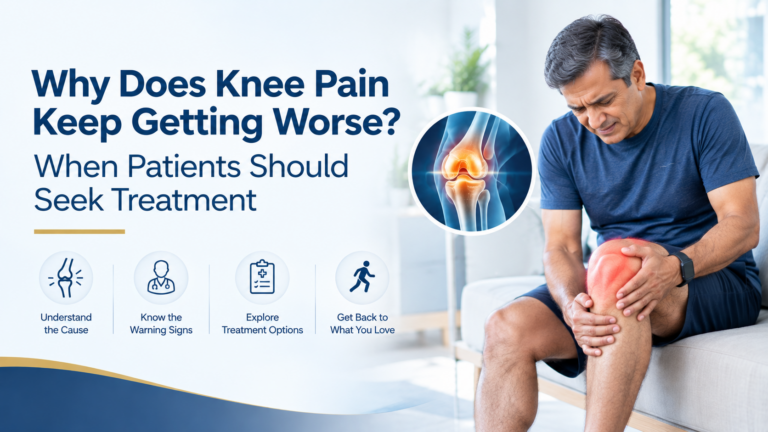

Knee pain that begins as an occasional ache after climbing stairs or a long walk often becomes harder to ignore over time. Many people in Bangalore manage knee pain with rest, painkillers, or home remedies for months, only to find that the discomfort keeps returning and starts to limit walking, sleep, and work. Dr. Abhinandan S. Punit, an Orthopaedic and Robotic Joint Replacement Surgeon in Bangalore with 15+ years of experience and 6,000+ orthopaedic surgeries, explains why knee pain keeps getting worse, which signs need attention, and when to seek treatment.
What Causes Knee Pain?
Knee pain can come from the bone, cartilage, ligaments, tendons, or the lining of the joint. Identifying the exact cause is the first step towards the right treatment.
- Osteoarthritis: gradual wear of the cartilage that cushions the joint, the most common cause of long-standing knee pain in adults.
- Ligament injuries: tears of the ACL or other ligaments, usually after twisting injuries or sports.
- Meniscus tears: damage to the shock-absorbing cartilage inside the knee, causing catching, locking, or swelling.
- Tendon problems: inflammation of the tendon below or above the kneecap, often from overuse.
- Bursitis and other arthritis: inflammation around the joint or conditions such as rheumatoid arthritis and gout.
Why Does Knee Pain Keep Getting Worse?
Knee pain often worsens because the underlying cause is still present. Painkillers and rest can reduce symptoms temporarily without changing what is happening inside the joint. Common reasons include:
- Cartilage wear that continues gradually when the joint is loaded every day.
- An untreated meniscus or ligament injury that changes how the knee carries weight.
- Extra body weight, which increases the load on the knee with every step.
- Weak thigh and hip muscles from reduced activity, which leave the joint with less support.
- Returning to the same activity before the knee has recovered.
- Reliance on painkillers that mask symptoms and delay assessment.
Knee pain does not worsen at the same rate in everyone, and not every case progresses. However, symptoms that keep returning or slowly increase are a signal that the cause needs to be examined.
How Does Knee Pain Change as It Gets Worse?
The pattern of knee pain often shifts as joint damage advances.
- Early stage: pain after activity, mild stiffness after sitting, and relief with rest.
- Middle stage: pain with stairs, squatting, or walking, occasional swelling, and morning stiffness that takes longer to ease.
- Advanced stage: pain at rest or at night, reduced walking distance, visible swelling or change in knee shape, and difficulty with routine tasks.
What Are the Signs That Knee Pain Needs Treatment?
Not every episode of knee pain needs surgery, but some signs should not be ignored. Important signs to discuss with an orthopaedic surgeon include:
- Knee pain that continues despite prescribed treatment.
- Difficulty walking, standing, or climbing stairs.
- Stiffness that limits bending or straightening.
- Swelling that keeps coming back.
- Pain that interrupts sleep.
- A knee that feels unstable or gives way.
- Reduced ability to work or carry out household activities.
Sudden severe swelling, fever, redness, a deformed knee, or an inability to bear weight after an injury needs prompt medical assessment.
When Should Patients Seek Treatment for Knee Pain?
An orthopaedic consultation is advisable when knee pain:
- Lasts more than two weeks despite rest and basic care.
- Keeps returning or is slowly increasing.
- Follows an injury such as a twist, fall or sports impact.
- Limits daily activities, work, or exercise.
- Needs regular painkillers to get through the day.
Consulting early does not mean committing to surgery. It allows the cause to be identified while more treatment options remain available.
How Is Knee Pain Diagnosed?
Accurate diagnosis shapes every treatment decision. An assessment for knee pain typically includes:
- A review of symptoms, previous injuries, and medical history.
- An examination of movement, swelling, alignment, and stability.
- X-rays to assess joint space and signs of arthritis.
- MRI, when indicated, to evaluate ligaments, menisci, and cartilage.
- A discussion of earlier treatments and how the knee responded.
What Are the Treatment Options for Knee Pain?
Treatment depends on the cause, severity of joint damage, overall health, and the patient’s goals.
- Non-surgical care: physiotherapy, prescribed medication, weight management, activity modification, bracing and, in suitable cases, injections. These approaches help many patients, particularly in earlier stages.
- Ligament and meniscus treatment: damaged structures may be repaired or reconstructed, for example through ACL reconstruction for a torn ligament, or managed through sports medicine care.
- Knee replacement: when joint damage is advanced and non-surgical treatment no longer provides adequate relief, knee replacement surgery may be considered. Robotic knee replacement surgery uses computer-assisted guidance for planning and implant positioning when it is medically appropriate. Patients can also read about robotic knee replacement recovery.
A surgeon should assess symptoms, examination findings, imaging, and expectations before recommending any procedure.
How Can Patients Protect Their Knees?
- Maintain a healthy body weight to reduce load on the joint.
- Build thigh and hip strength with exercises guided by a physiotherapist.
- Choose low-impact activities such as walking, cycling or swimming where suitable.
- Wear supportive footwear and warm up before exercise.
- Avoid pushing through sharp or increasing pain.
Why Consult Dr. Abhinandan Punit for Knee Pain in Bangalore?
Dr. Abhinandan S. Punit is a Senior Consultant and Clinical Lead in Joint Replacement and an Orthopaedic and Robotic Joint Replacement Surgeon in Bangalore. He has 15+ years of clinical and surgical experience and has performed 6,000+ orthopaedic surgeries. His qualifications include MS Orthopaedics, DNB Orthopaedics, MCh Orthopaedics from the University of Edinburgh and MSc Sports & Exercise Medicine from the University of South Wales.
With training in both sports medicine and robotic joint replacement, he evaluates knee pain based on symptoms, imaging, medical history and treatment goals. Consultations are available at Elite Orthocare & Multi-Speciality Clinic on Kanakapura Road and at Narayana Health City, Bangalore. Learn more about Dr. Abhinandan Punit.
Conclusion: Do Not Wait for Knee Pain to Become Unbearable
Knee pain that keeps getting worse is rarely a problem that resolves on its own. Understanding the cause, recognising warning signs and seeking an orthopaedic assessment early can help patients protect mobility, sleep and independence. Many people improve with non-surgical care, and knee replacement is considered only when it is medically appropriate.
Dr. Abhinandan S. Punit, an Orthopaedic and Robotic Joint Replacement Surgeon in Bangalore, provides assessment and treatment planning for patients with knee pain, from injuries to advanced arthritis.
Book Your Consultation
Knee pain that keeps returning or limits daily life deserves a proper assessment. Book your consultation with Dr. Abhinandan Punit to discuss your symptoms and suitable treatment options.
Frequently Asked Questions
Why does my knee pain get worse at night?
Knee pain can feel worse at night because the joint is still and inflammation may build up, and pain at rest is more common as arthritis advances. Pain that regularly disturbs sleep should be assessed by an orthopaedic surgeon.
Is walking good or bad for knee pain?
Gentle, regular walking helps many patients keep the joint moving and the muscles strong. However, pain that increases during or after walking, or swelling that follows activity, should be examined rather than ignored.
Can knee pain go away on its own?
Mild strains and overuse pain often settle within a few weeks with rest and care. Knee pain that persists, keeps returning or gradually worsens usually has an underlying cause that needs assessment.
How can I tell if knee pain is caused by arthritis?
Arthritis commonly causes stiffness after rest, pain with stairs or squatting, swelling and a grinding sensation. These symptoms can also occur with other conditions, so examination and imaging are needed to confirm the cause.
Does knee pain always mean I need a knee replacement?
No. Many patients manage knee pain with physiotherapy, medication, weight management and activity changes. Knee replacement is considered when joint damage is advanced and non-surgical treatment has not provided adequate relief.
Whom should I consult for knee pain in Bangalore?
Patients should consult a qualified orthopaedic surgeon with experience in knee conditions, sports injuries and joint replacement. Dr. Abhinandan S. Punit is an Orthopaedic and Robotic Joint Replacement Surgeon in Bangalore with 15+ years of experience and 6,000+ orthopaedic surgeries, and patients can arrange an assessment to discuss their symptoms and treatment options.