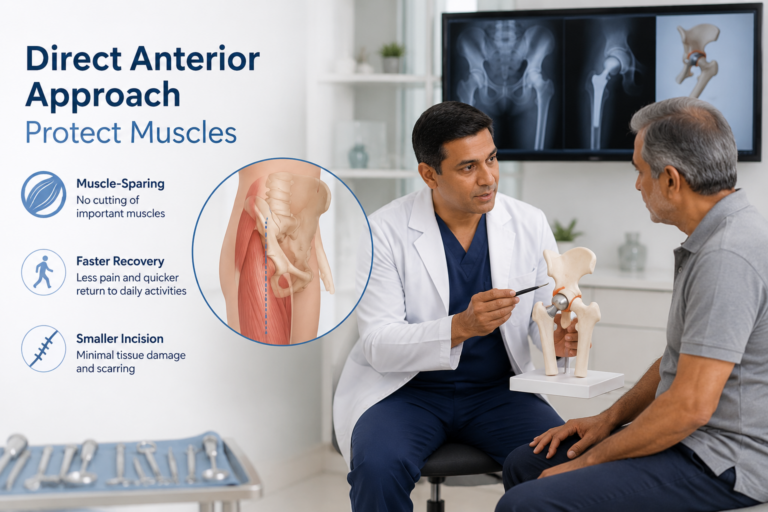

What Is Anterior Hip Dislocation Reduction?
Anterior hip dislocation reduction is a medical procedure used to reposition the hip joint when the femoral head (ball) slips out of the socket toward the front. This condition usually occurs due to trauma, accidents, or high-impact injuries and requires immediate medical attention. The reduction process involves carefully guiding the joint back into its normal position using specific manual techniques or, in some cases, surgery.
What Causes Anterior Hip Dislocation?
Anterior hip dislocation typically happens due to:
- High-impact trauma such as road accidents
- Sports injuries involving sudden force or twisting
- Falls, especially in older adults
- Previous hip surgery or joint instability
This type of dislocation is less common than posterior dislocation but can still lead to serious complications if not treated quickly.
How Is Anterior Hip Dislocation Reduced?
Reduction of anterior hip dislocation is usually performed as an emergency procedure. Doctors use controlled movements to guide the hip joint back into place. This is known as closed reduction, which is done without surgery.
During the procedure, the patient is given sedation or anesthesia to relax the muscles and reduce pain. The doctor then carefully manipulates the leg, applying traction and gentle rotation to reposition the femoral head into the socket.
If closed reduction is unsuccessful or if there are associated fractures, open reduction surgery may be required. In this case, the surgeon makes an incision to directly access and realign the joint.
Steps Involved in Hip Dislocation Reduction
The process generally includes:
- Administering anesthesia or sedation
- Applying traction to the leg
- Gentle manipulation of the hip joint
- Confirming alignment using imaging (X-ray or CT scan)
The entire procedure is performed under strict medical supervision to avoid complications.
Signs You May Have an Anterior Hip Dislocation
Common symptoms include:
- Severe hip pain
- Inability to move the leg
- Visible deformity in the hip joint
- The leg positioned outward and slightly rotated
- Swelling and tenderness
Immediate medical evaluation is necessary if these symptoms appear after trauma.
Risks and complications associated with hip dislocation reduction
- The reduction procedure to treat a dislocated hip has The procedure is generally safe, but possible risks include: Complications associated with hip reduction include:
- Damage to your nerves
- Damage to your blood vessels
- Re dislocate hip
- Stiffness in joint
- Loss of blood flow to the bone (avascular necrosis)
- Proper technique and early intervention can help reduce complications.
Recovery following anterior hip dislocation reduction
- The amount of recovery time will be determined by the severity of the dislocated hip and method of treatment. Maintaining the following guidelines will help ensure your recovery:
- Limited rest and movement early after dislocation.
- Using crutches or other support for ambulation (walking).
- Physiotherapy to restore muscle strength and improve mobility.
- Time to recover can vary from a short period of days to many months (a physician’s recommendations are important for experiencing a successful recovery).
When is surgical treatment needed?
Further treatment may be required if further complications develop that do not allow the hip to be returned to its normal position following a hip dislocation reduction. The treatment options to manage this type of injury typically include both a non-operative or “manual” approach and an operative or “surgical” approach (i.e. total hip arthroplasty). In cases where it is impossible to reposition the hip joint using non-operative techniques, surgical intervention (surgical repair) will often be necessary due to associated fractures involving the femoral or acetabular components of the joint, as well as significant soft tissue damage or instability of the hip joint following a manual reduction; all requiring surgical intervention. The goal of surgical treatment is to properly restore alignment to the hip joint and decrease the risk for future dislocations or chronic joint complications.
Preventing Hip Dislocation
- To help decrease the risk of experiencing a dislocated hip, you should do the following:
- Avoid participating in potentially high-risk activities without appropriate protection (e.g., pads, helmet, during impact sports).
- Strengthening your hip muscles and surrounding legs.
- Utilizing seat belts and other safety measures while travelling.
- Maintaining or improving your bone health, especially in the older population.
Conclusion
Restoring the normal position of the hip joint after injury through reduction of anterior hip dislocation has a crucial role in order to avoid long-lasting problems. The sooner treatment begins, the better chance for proper recovery. A majority of patients will achieve normal motion and function by closely following their prescribed rehabilitation program and receiving treatments from their healthcare provider.
About Dr. Abhinandan Punit
On top of being a European Board-Certified Orthopaedic Surgeon in Bangalore, Dr. Abhinandan S Punit runs Elite Orthocare Multi-Speciality Clinic as its founder. Holding a senior consultant role, he leads robotic joint replacement efforts at Narayana Hospital – experience stretching beyond 15 years shapes his work there.
Every year, he carries out more than two thousand operations to replace joints, using robot-assisted techniques for knees along with less invasive methods. Total knee replacements fall within his skill set, just like partial ones, plus experience with high-tech robotics – think MAKO, then Cuvis, followed by Cori. Though numbers stack up, precision stays sharp across each case handled.
FAQs About Reduction of Anterior Hip Dislocation
What does the term reduction of anterior hip dislocation mean?
Reduction of anterior hip dislocation means the treatment process that occurs as a result of dislocation of the leg forward. The dislocation may be caused by either trauma or injuries.
Does pain exist in reduction of anterior hip dislocation?
Reduction of anterior hip dislocation is done using anesthesia and therefore one undergoing the process cannot experience any pain. However, one can still experience mild pain once the process has ended.
How long should recovery be expected when the dislocation is reduced?
The amount of time that may be required to recover from the process may vary depending on how complicated the dislocation is. For instance, simple cases take less time than complex cases.
Can one suffering from anterior hip dislocation suffer from the same problem again?
If a person disregards the instructions given by his or her doctor regarding post-treatment care, they can get another dislocation again.